

Water Cooled Chillers
About Company
Water Cooled Chillers – Working, Types, Benefits, Applications & Selection Guide
Water cooled chillers are one of the most reliable and energy-efficient cooling solutions used in industrial and commercial applications. From plastic processing plants and pharmaceutical facilities to food processing units and large HVAC systems, water cooled chillers play a crucial role in maintaining precise temperature control and ensuring uninterrupted production.
In this detailed guide, we will explain what water cooled chillers are, how they work, their main components, advantages, applications, types, and how to select the right water cooled chiller for your industry.
What Is a Water Cooled Chiller?
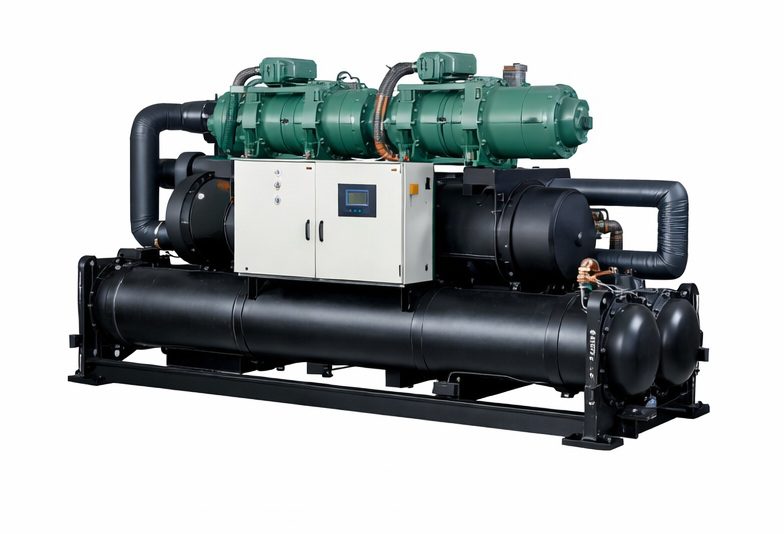
A water cooled chiller is a refrigeration system that removes heat from a process or space by circulating chilled water. The absorbed heat is then rejected through a cooling tower using condenser water instead of air.
Unlike air cooled chillers, which dissipate heat directly into the atmosphere using fans, water cooled chillers rely on water as a heat transfer medium. This makes them highly efficient, especially for continuous industrial operations and large cooling loads.
How Does a Water Cooled Chiller Work?
The working principle of a water cooled chiller is based on the vapour compression refrigeration cycle. The system continuously absorbs heat from the process and rejects it through condenser water.
Advantages of Water Cooled Chillers
Water cooled chillers are preferred in industries where efficiency, reliability, and performance matter.
One
Higher Energy Efficiency: Water is a better heat transfer medium than air, resulting in lower power consumption
Two
Stable Performance: Unaffected by ambient air temperature fluctuations, ensuring consistent cooling throughout the year.
Three
Lower Operating Cost: Although initial installation cost is higher, long-term energy savings are significant.

Process of Water cooled Chiller

Main Components of a Water Cooled Chiller
A water cooled chiller consists of several critical components working together:
1. Compressor
The heart of the chiller system. Common compressor types include:
Reciprocating compressors
Scroll compressors
Screw compressors
Centrifugal compressors
2. Evaporator
Typically a shell and tube heat exchanger, where chilled water absorbs heat from the process.
3. Condenser
Also a shell and tube type, where heat is transferred to condenser water supplied by the cooling tower.
4. Expansion Valve
Controls refrigerant flow and maintains correct pressure levels.
5. Cooling Tower
Rejects heat from condenser water into the atmosphere.
6. Pumps & Controls
Ensure smooth water circulation, system safety, and temperature accuracy.
How Does a Water Cooled Chiller Work?
Heat Absorption (Evaporator)
Chilled water absorbs heat from the process or equipment. This heat causes the refrigerant inside the evaporator to evaporate.
Compression (Compressor)
The low-pressure refrigerant gas is compressed into a high-pressure, high-temperature gas.
Heat Rejection (Condenser)
The hot refrigerant gas releases heat to condenser water flowing from the cooling tower. The refrigerant condenses into a liquid state.
Expansion (Expansion Valve)
The liquid refrigerant passes through an expansion valve, reducing pressure and temperature before re-entering the evaporator.

Request For Free Consultation
Request a Free Consultation from a Leading Chiller Manufacturer
“Get technical consultation from a certified chiller manufacturer and supplier.
We help you select the right chiller system for maximum efficiency and precise temperature control.“
Types & Applications
Types of Water Cooled Chillers
Water cooled chillers are classified based on compressor type and application requirements.
1. Water Cooled Reciprocating Chillers
Ideal for small to medium cooling capacities. Known for simplicity and cost-effectiveness.
2. Water Cooled Scroll Chillers
Offer quiet operation, higher efficiency, and low maintenance. Suitable for consistent load conditions.
3. Water Cooled Screw Chillers
Designed for medium to large industrial loads. Highly reliable for continuous 24/7 operations.
4. Water Cooled Centrifugal Chillers
Used in large HVAC systems and industrial plants requiring very high cooling capacities.
Applications of Water Cooled Chillers
Water cooled chillers are widely used across multiple industries:
1. Plastic & Injection Molding Industry
Maintains precise mold temperature for better product quality.
2. Pharmaceutical & Chemical Industry
Ensures accurate temperature control for sensitive processes.
3. Food & Beverage Industry
Used in breweries, dairies, cold processing, and storage applications.
4. HVAC Systems
Provides centralized cooling for commercial buildings, malls, and hospitals.
5. Rubber, Textile & Lamination Plants
Prevents overheating and ensures consistent production output.