

Selecting the right chiller is a critical decision for any industrial or commercial facility. A chiller is not just a piece of equipment—it directly affects process stability, energy consumption, production quality, and operating cost. Unfortunately, many users end up with performance issues, frequent breakdowns, or high electricity bills due to mistakes made during the selection stage.
This article highlights the most common mistakes while selecting a chiller and explains how to avoid them for long-term, trouble-free operation.
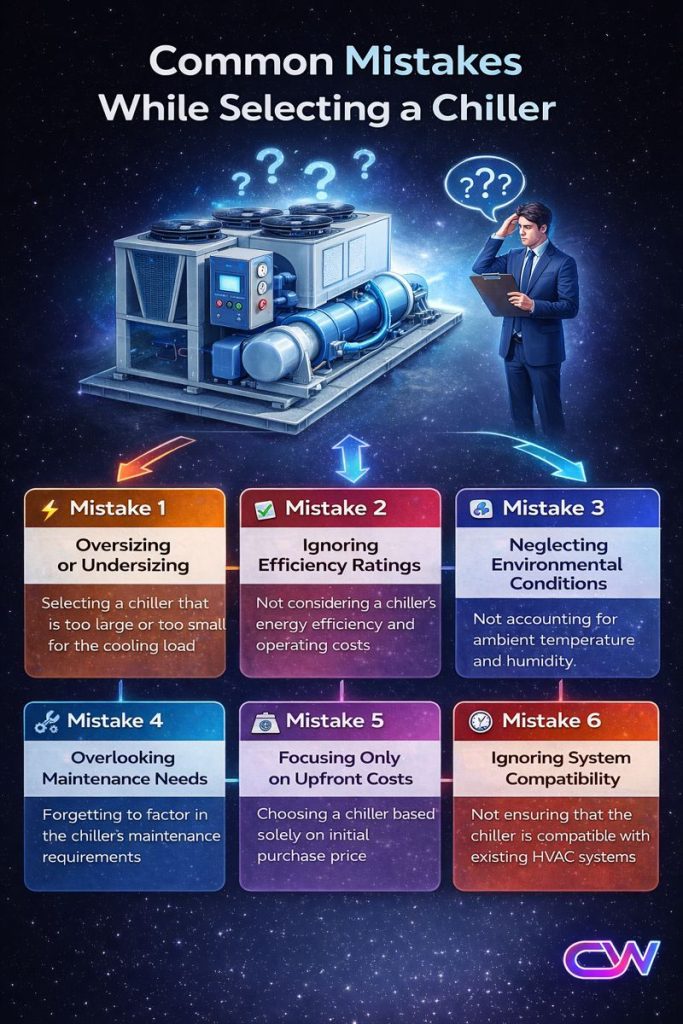
1. Incorrect TR Load Calculation
One of the biggest and most common mistakes is wrong TR (Ton of Refrigeration) calculation.
Many users:
- Guess the capacity
- Select chiller based on machine tonnage only
- Use standard thumb rules without understanding actual heat load
An undersized chiller fails to maintain temperature, while an oversized chiller leads to short cycling and higher power consumption.
Solution:
Always calculate TR based on:
- Actual heat load
- Flow rate
- Temperature difference
- Operating conditions
2. Oversizing the Chiller “Just to Be Safe”
Some buyers intentionally select a higher capacity chiller thinking it will provide safety and future flexibility.
In reality, oversizing causes:
- Frequent ON/OFF cycling
- Poor part-load efficiency
- Higher capital cost
- Reduced compressor life
Solution:
Add a controlled safety margin (10–20%), not excessive capacity.
3. Ignoring Ambient Temperature Conditions
Ambient temperature plays a major role in chiller performance, especially for air-cooled chillers.
Common mistakes include:
- Selecting chiller based on average temperature
- Ignoring peak summer conditions
High ambient temperatures reduce actual cooling capacity and increase power consumption.
Solution:
Always consider maximum site ambient temperature during selection.
4. Wrong Choice Between Air-Cooled and Water-Cooled Chiller
Many users select chiller type based only on initial cost.
Mistakes include:
- Choosing air-cooled chiller for large continuous loads
- Choosing water-cooled chiller without proper water availability
This leads to higher operating costs or operational difficulties.
Solution:
Select chiller type based on:
- Cooling capacity
- Operating hours
- Water availability
- Energy efficiency goals
5. Not Considering Load Variation
Not all processes operate at constant load.
Ignoring load variation can result in:
- Temperature fluctuation
- Poor efficiency
- Compressor stress
This is common in batch processes, plastic molding, and HVAC systems.
Solution:
Choose chillers with:
- Capacity control
- Multiple compressors
- VFD options
6. Ignoring Future Expansion Plans
Selecting a chiller only for today’s requirement can create problems tomorrow.
Mistakes include:
- No provision for future machines
- No space planning for expansion
This leads to costly system upgrades or additional chillers later.
Solution:
Discuss future expansion during initial selection and plan accordingly.
7. Overlooking Cooling Medium (Water vs Glycol)
Using glycol instead of water without adjusting capacity is a serious mistake.
Glycol:
- Reduces heat transfer efficiency
- Increases pump power
Failure to account for this results in insufficient cooling.
Solution:
Increase chiller capacity when using glycol, based on concentration.
8. Neglecting Energy Efficiency Ratings
Many buyers focus only on chiller price, ignoring energy efficiency.
This results in:
- High electricity bills
- Longer payback period
- Poor long-term economics
Solution:
Compare chillers based on:
- kW/TR
- COP and EER
- Part-load efficiency
9. Poor Installation Planning
Even the best chiller performs poorly if installed incorrectly.
Common issues:
- Inadequate airflow for air-cooled chillers
- Improper piping design
- Lack of service access
Solution:
Ensure proper installation layout and follow manufacturer guidelines.
10. Ignoring Maintenance and Service Support
Selecting a chiller without considering service support leads to long downtimes.
Mistakes include:
- No local service availability
- Difficult access to spares
- Complex maintenance requirements
Solution:
Choose a supplier with strong service and spare support.
11. Not Considering Power Supply Conditions
Ignoring electrical conditions can damage compressors and controls.
Common issues:
- Voltage fluctuation
- Inadequate electrical protection
- Wrong power rating selection
Solution:
Ensure power supply compatibility and protection systems.
12. Ignoring Water Quality (For Water-Cooled Chillers)
Poor water quality causes:
- Scaling
- Corrosion
- Reduced heat transfer
This directly impacts performance and efficiency.
Solution:
Include proper water treatment and filtration during planning.
How Chillerwala Helps Avoid These Mistakes
At Chillerwala, chiller selection is based on:
- Detailed heat load analysis
- Site condition study
- Energy efficiency evaluation
- Application-specific design
This ensures customers get a reliable, efficient, and cost-effective chiller solution.
Conclusion
Most chiller problems start with poor selection decisions. Incorrect TR calculation, oversizing, ignoring ambient conditions, and focusing only on initial cost are common mistakes that lead to long-term issues. By understanding these mistakes and taking a systematic approach to selection, you can ensure stable cooling performance, lower operating cost, and longer equipment life.
Choosing the right chiller is not about buying a bigger machine—it’s about buying the right machine for your application.