

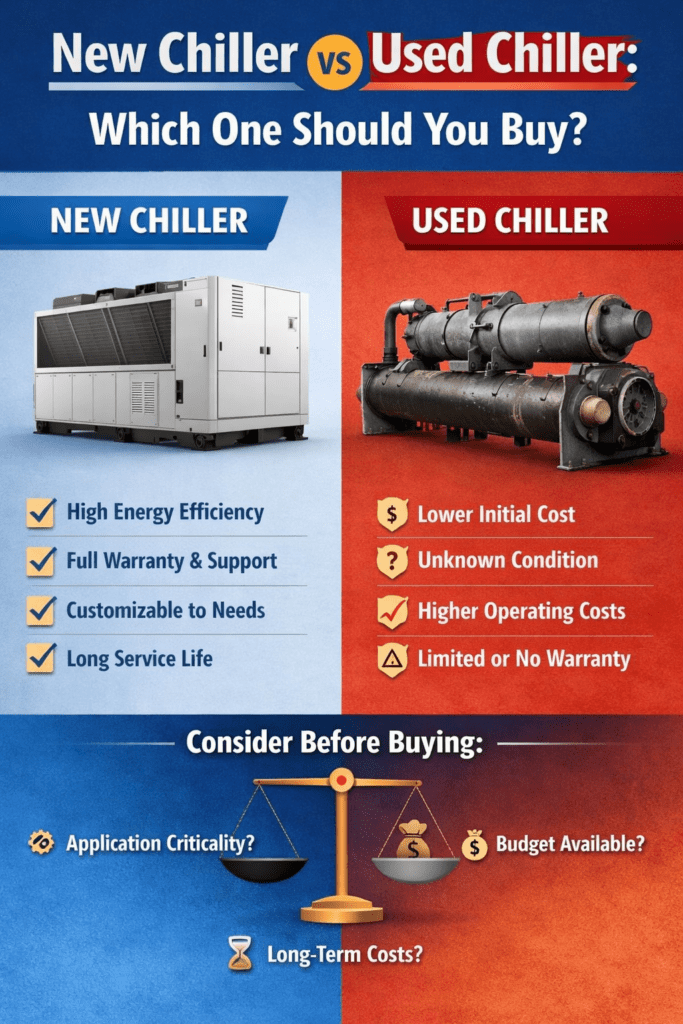
When planning a cooling system for an industrial or commercial application, one of the most common questions buyers face is whether to invest in a new chiller or go for a used chiller. At first glance, a used chiller may look attractive due to its lower upfront cost, while a new chiller promises better performance and peace of mind.
However, the right choice depends on several factors such as application criticality, operating hours, energy cost, reliability expectations, and long-term plans. This article provides a clear and honest comparison between new chillers and used chillers to help you make an informed decision.
Understanding the Difference Between New and Used Chillers
A new chiller is manufactured, tested, and supplied as per current design standards, with full warranty and technical support. A used chiller (also called refurbished or pre-owned chiller) has already been in operation and may have been reconditioned before resale.
Both options have their place, but selecting the wrong one can lead to unexpected costs and downtime.
Advantages of Buying a New Chiller
1. Higher Energy Efficiency
New chillers are designed with:
- Advanced compressor technology
- Improved heat exchangers
- Better control systems
This results in lower kW/TR, reduced power consumption, and long-term energy savings. In continuous operations, energy savings alone can justify the higher initial cost.
2. Reliable Performance and Consistency
New chillers offer:
- Stable cooling capacity
- Accurate temperature control
- Minimal breakdown risk
For industries like pharmaceuticals, food processing, data centers, and chemical plants, consistent performance is critical.
3. Warranty and Manufacturer Support
One of the biggest benefits of a new chiller is:
- Manufacturer warranty
- Availability of original spares
- Technical documentation
- After-sales support
This reduces risk and ensures faster issue resolution.
4. Customization as per Application
New chillers can be customized for:
- Required temperature range
- Ambient conditions
- Process-specific needs
- Future expansion
Used chillers rarely offer this flexibility.
5. Longer Service Life
A new chiller provides:
- Full equipment lifespan
- Lower maintenance cost initially
- Better return on investment over time
Disadvantages of Buying a New Chiller
- Higher initial investment
- Longer delivery time in some cases
However, these drawbacks are often offset by lower operating and maintenance costs.
Advantages of Buying a Used Chiller
1. Lower Initial Cost
The main reason buyers consider used chillers is the significantly lower purchase price. This is suitable when:
- Budget is limited
- Cooling requirement is temporary
- Application is non-critical
2. Faster Availability
Used chillers are often available immediately, making them useful for:
- Emergency replacement
- Short-term projects
- Trial or pilot plants
3. Suitable for Low-Duty Applications
For applications with:
- Low operating hours
- Seasonal usage
- Non-critical temperature control
A used chiller can be a cost-effective solution.
Risks and Limitations of Used Chillers
1. Unknown Operating History
Most used chillers come with:
- Limited or no operating history
- Unknown load conditions
- Uncertain maintenance records
This increases the risk of unexpected failures.
2. Lower Energy Efficiency
Older chillers:
- Consume more power
- Lack modern control features
- Have worn-out components
Higher electricity costs over time can eliminate the initial savings.
3. Limited or No Warranty
Used chillers usually come with:
- Short-term testing warranty
- Limited service support
Major component failure can result in high repair costs.
4. Compatibility Issues
Used chillers may:
- Not match your exact capacity requirement
- Be incompatible with current refrigerants
- Require system modifications
This adds hidden costs.
Comparison: New Chiller vs Used Chiller
| Parameter | New Chiller | Used Chiller |
|---|---|---|
| Initial Cost | Higher | Lower |
| Energy Efficiency | High | Moderate to Low |
| Reliability | Excellent | Variable |
| Warranty | Full | Limited or None |
| Customization | Yes | No |
| Maintenance Cost | Low initially | Higher |
| Lifespan | Long | Uncertain |
Which One Should You Choose?
Choose a New Chiller If:
- Cooling is critical to production
- Operating hours are high
- Energy efficiency is a priority
- Long-term reliability is required
- You want peace of mind
Choose a Used Chiller If:
- Budget is limited
- Application is temporary
- Operating hours are low
- Backup cooling is required
Total Cost of Ownership (TCO) Matters
Many buyers focus only on initial cost and ignore total cost of ownership.
A new chiller may:
- Cost more initially
- Save money in electricity
- Reduce breakdown and maintenance cost
Over 5–10 years, a new chiller often becomes more economical than a used one.
Important Checks Before Buying a Used Chiller
If you decide to buy a used chiller, always check:
- Compressor condition
- Refrigerant type and availability
- Electrical panel health
- Heat exchanger condition
- Load testing report
Buying from a trusted supplier is critical.
How Chillerwala Helps You Make the Right Choice
At Chillerwala, customers are guided based on:
- Application requirement
- Budget constraints
- Operating pattern
- Long-term cost evaluation
Whether it is a new chiller or a refurbished solution, the focus remains on reliability, efficiency, and customer satisfaction.
Conclusion
Choosing between a new chiller and a used chiller is not just about price—it’s about reliability, efficiency, and long-term value. While used chillers can work for limited or temporary needs, new chillers offer superior performance, energy savings, and peace of mind for critical applications.
Understanding your application and evaluating total ownership cost will help you make the right investment decision.