

Chiller for Injection Molding

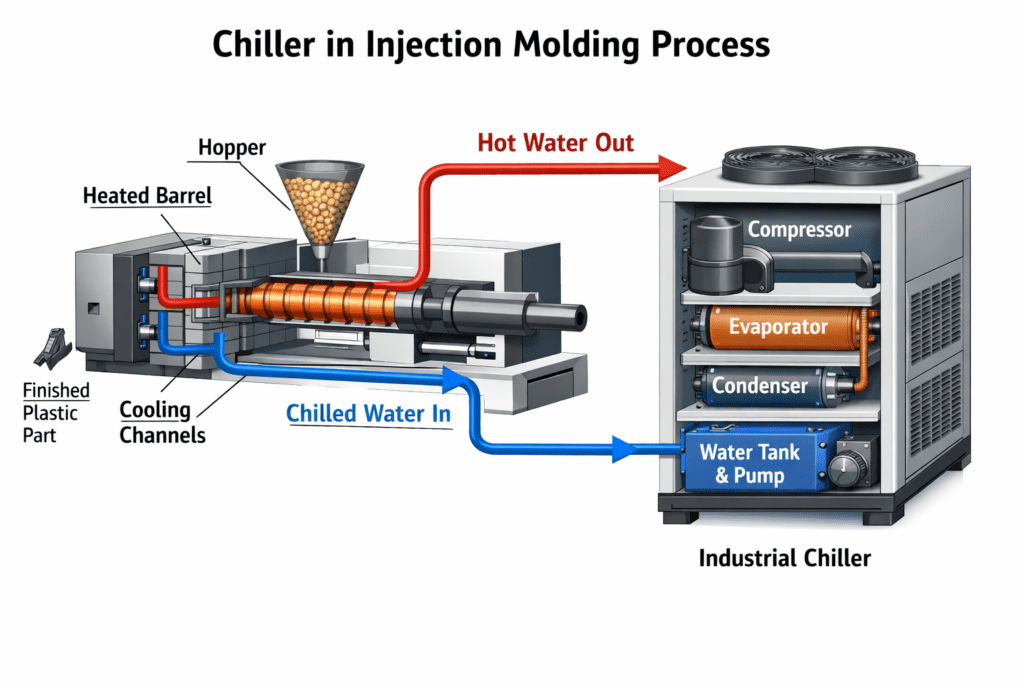
Chiller for Plastic Injection Molding Industry – Why Temperature Control Is Critical
The plastic injection molding industry is one of the fastest-growing manufacturing sectors in the world. From automotive components and medical devices to packaging containers and electronic housings, injection molding plays a vital role in producing high-precision plastic products.
However, many manufacturers focus mainly on molds, raw materials, and injection machines while overlooking one crucial element — temperature control. Without proper cooling, plastic parts may deform, production cycles become longer, and overall product quality decreases.
This is where a chiller for plastic injection molding becomes an essential part of the manufacturing process.
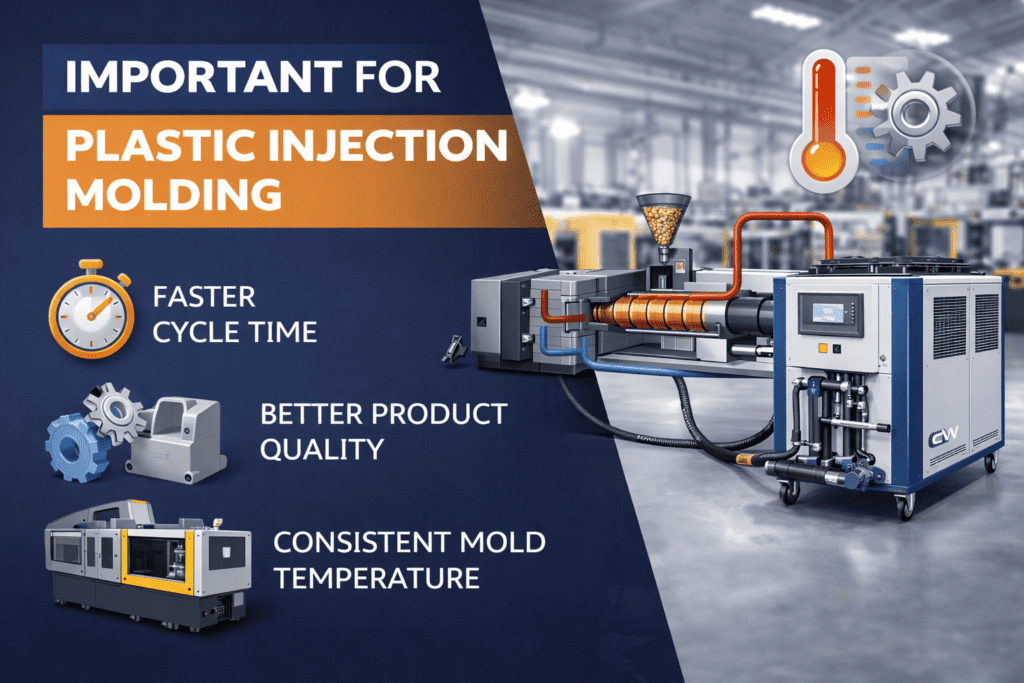
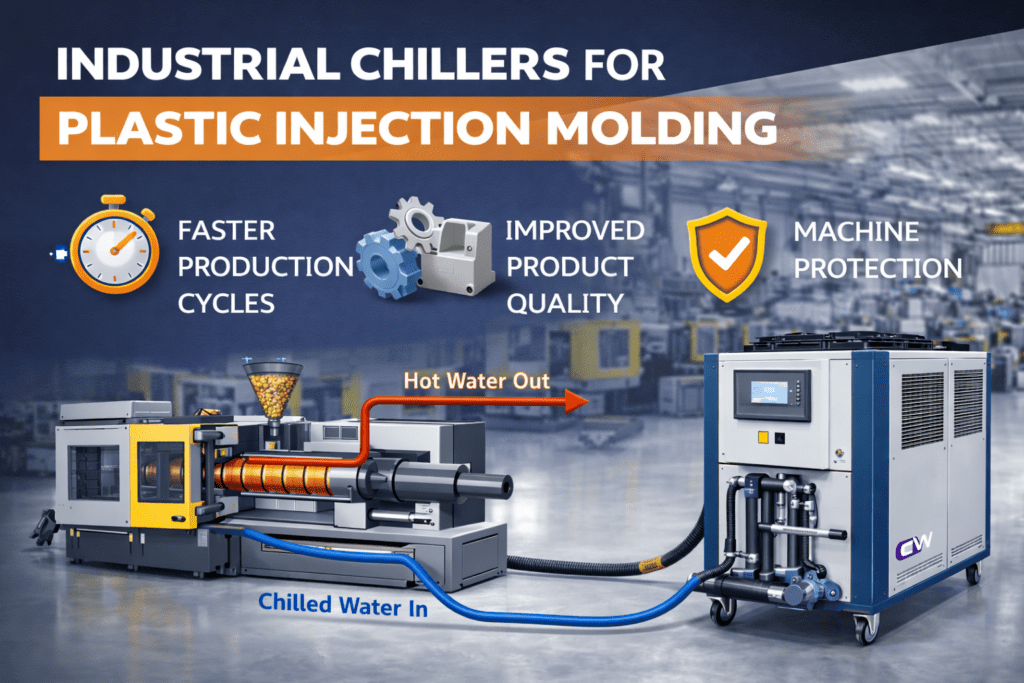
Industrial chillers help maintain a consistent mold temperature, improve cycle time, enhance product quality, and protect expensive machinery from overheating. In modern injection molding plants, a reliable chiller system is not just an accessory; it is a core component of the production line.
In this, we will explore how chillers work in plastic injection molding, why they are necessary, the types of chillers used, and how to select the right chiller for your plant.
Understanding the Injection Molding Cooling Process
To understand the importance of a chiller, it is necessary to first understand how injection molding works.
The injection molding process typically involves four stages:
- Plastic melting
- Injection into the mold
- Cooling and solidification
- Ejection of the finished part
Among these stages, cooling consumes the largest portion of the cycle time.
Once molten plastic is injected into the mold cavity, it must cool down and solidify before the mold can open and release the finished product. If cooling is slow or inconsistent, several problems can occur:
✖ Warping of plastic parts
✖ Uneven shrinkage
✖ Surface defects
✖ Increased production cycle time
✖ Reduced production efficiency
Why Chillers Are Important for Plastic Injection Molding
Many small factories initially rely on cooling towers or ambient water systems. While these may work in mild climates, they cannot maintain precise temperature control required for modern injection molding operations.
A properly designed chiller offers several advantages.
1. Faster Production Cycle
Cooling time accounts for 50–70% of the injection molding cycle. When a chiller is used, the mold cools faster, allowing the machine to produce more parts in less time.
2. Improved Product Quality
A chiller maintains consistent mold temperature, ensuring uniform cooling of plastic parts. This results in better dimensional stability and improved surface finish. High-precision industries such as automotive, electronics, and medical plastics require strict temperature control to meet quality standards.
3. Protection of Injection Molding Machines
Injection molding machines operate under high pressure and temperature conditions. Excessive heat can damage hydraulic systems, oil circuits, and machine components.
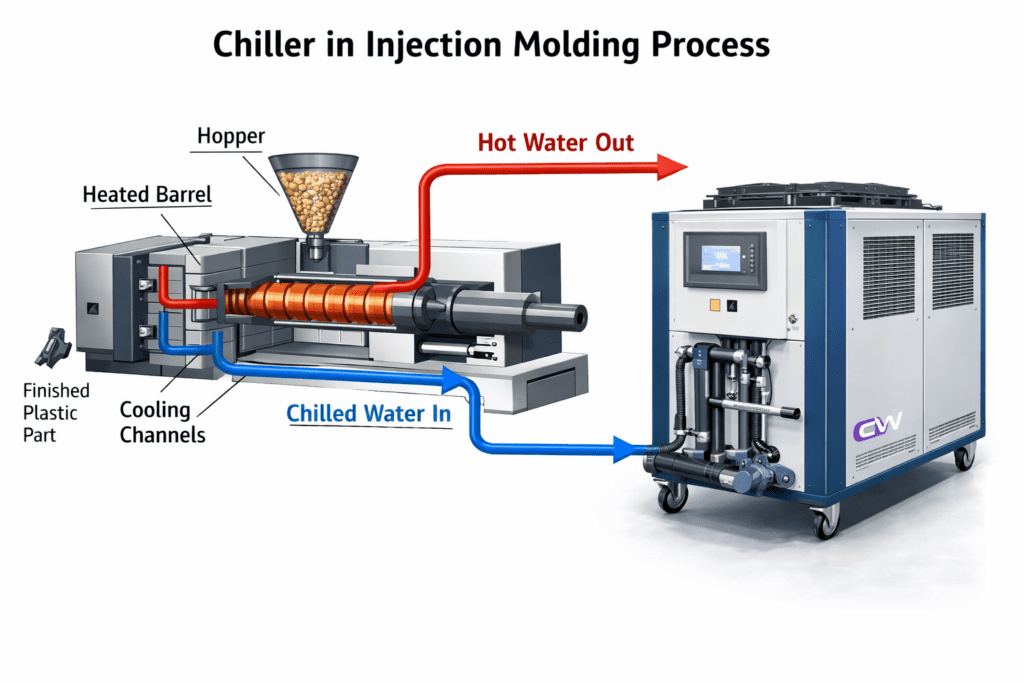
Types of Chillers Used in Plastic Injection Molding
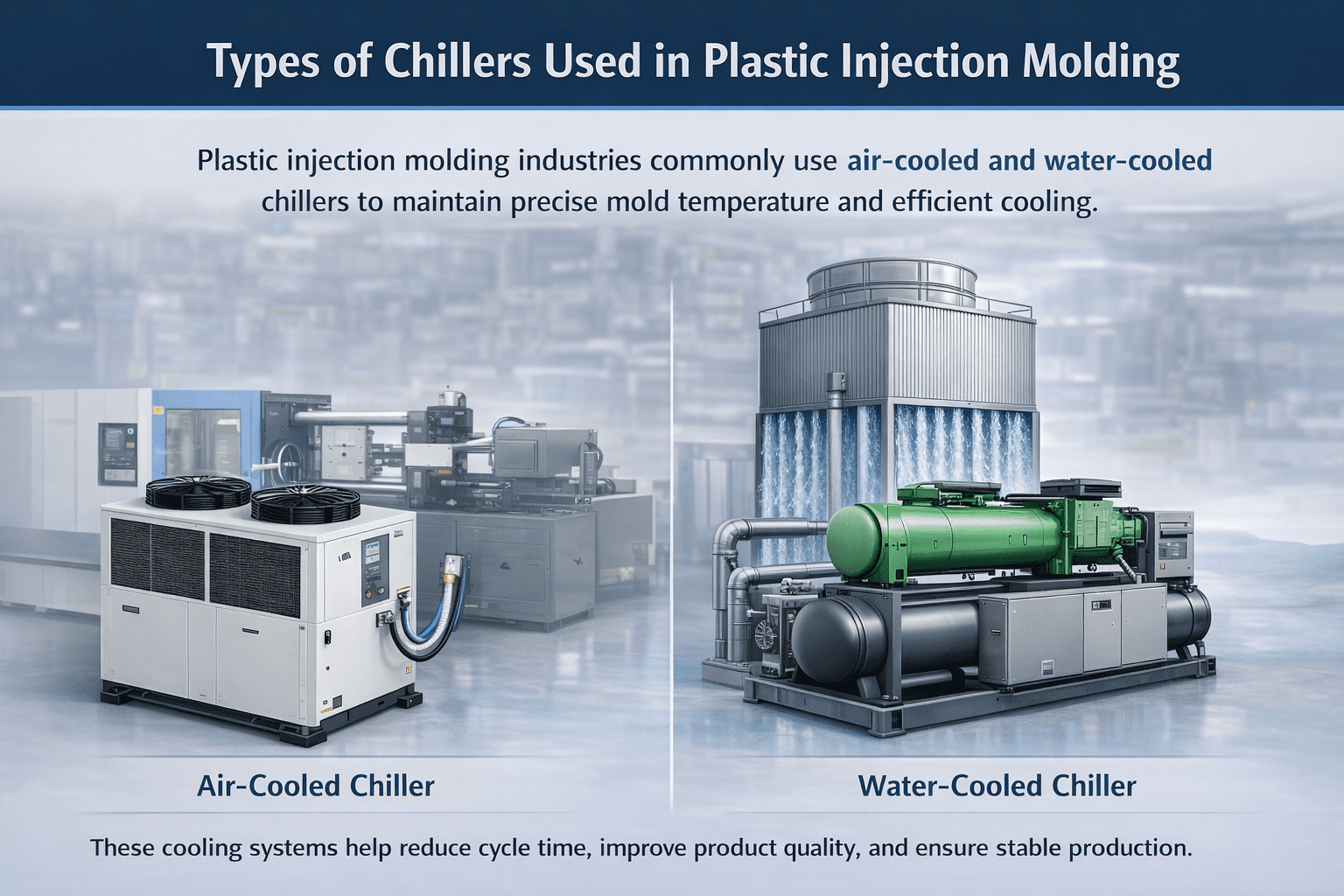
Air-cooled and water-cooled industrial chillers are widely used in plastic injection molding for effective mold cooling.
They help manufacturers maintain stable temperatures, faster cycles, and high-quality plastic parts.
Air Cooled Chiller
Air-cooled chillers remove heat using ambient air through condenser coils and cooling fans. They are ideal for plastic injection molding plants where easy installation and low water usage are important.
Water-Cooled Chiller
Water-cooled chillers use a cooling tower to remove heat and deliver highly efficient mold cooling. They are widely used in large injection molding plants requiring stable temperature control and continuous production.
Process of Injection Molding Cooling using a Water-Cooled Chiller
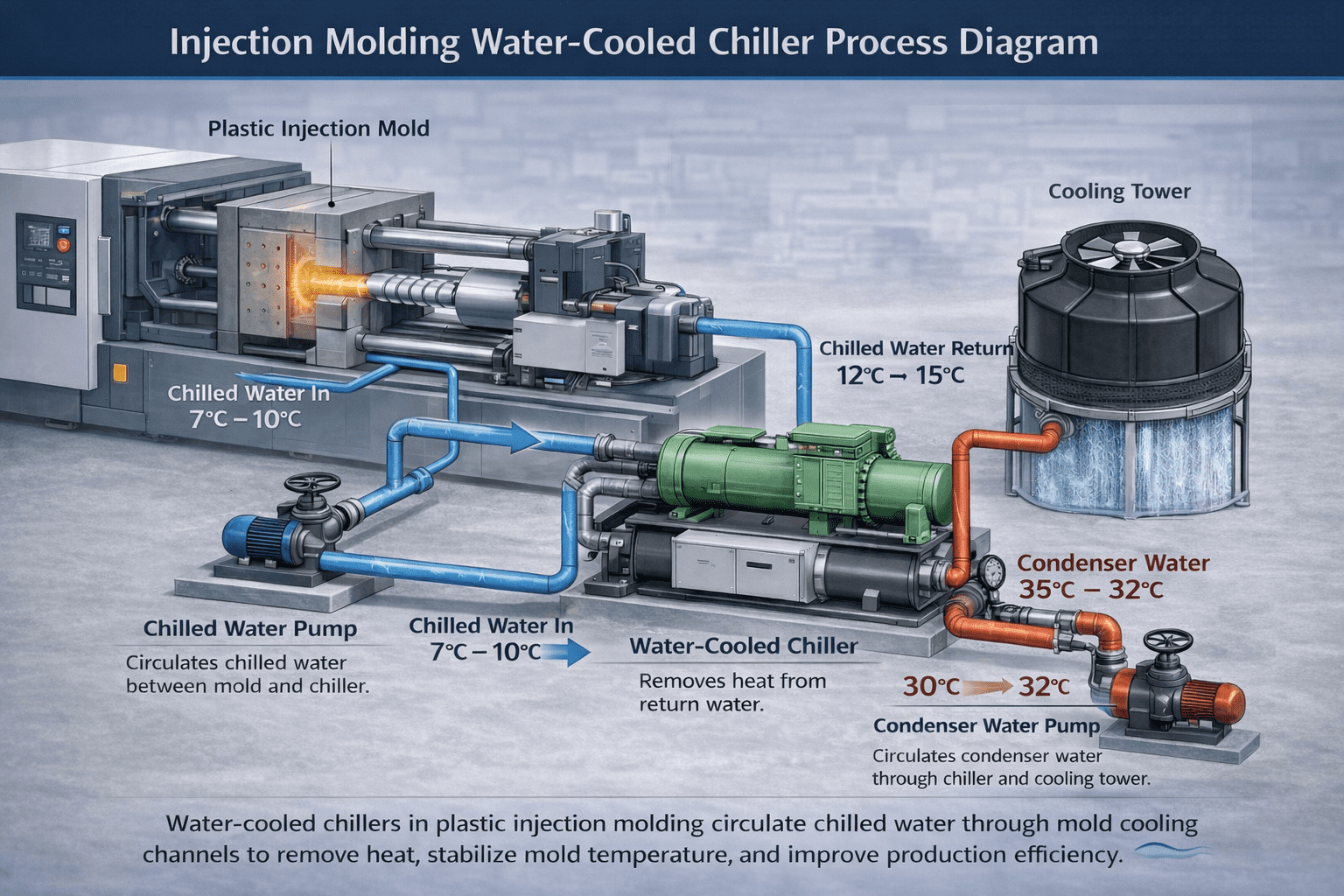
Step-by-Step Working Process
Heat Absorption (Mold Cooling)
Chilled water at 7°C – 10°C flows through the cooling channels of the injection mold. This water absorbs heat from the molten plastic inside the mold and helps the plastic solidify quickly.
Heat Transfer (Chilled Water Return)
After absorbing heat from the mold, the water temperature rises to 12°C – 15°C and returns to the water-cooled chiller through the chilled water return line.
Heat Removal (Evaporator in Chiller)
Inside the chiller evaporator, the refrigerant absorbs heat from the return water. This cools the water again to 7°C – 10°C so it can be reused in the mold cooling process.
Heat Rejection (Condenser Section)
The hot refrigerant releases its heat in the condenser to condenser water circulating through the system.
Cooling Tower Heat Dissipation
The condenser water carrying heat flows to the cooling tower, where heat is rejected to the atmosphere. The cooled water then returns to the chiller condenser.
Continuous Cooling Cycle
This continuous circulation of chilled water, refrigerant, and condenser water maintains stable mold temperature, ensuring fast cooling, improved product quality, and higher production efficiency in the injection molding process.
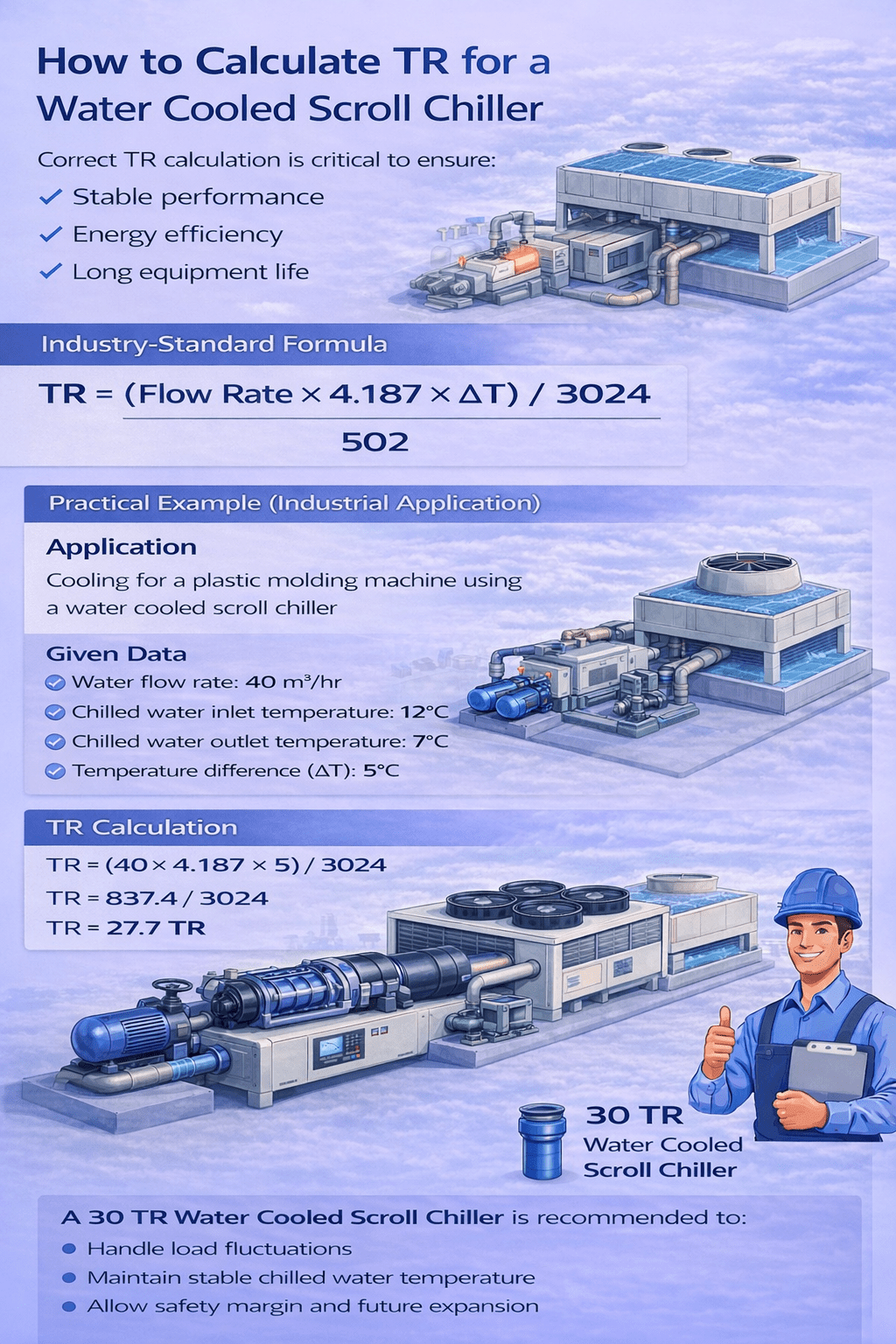
How to Calculate Water Cooled Scroll Chiller Capacity in TR (With Example)
Standard TR Formula (Water Cooled Chiller)
TR=3024Flow Rate×4.187×ΔT Where:
Flow Rate = Chilled water flow in m³/hr
ΔT = Temperature difference between inlet & outlet water (°C)
4.187 = Specific heat of water
3024 = Conversion constant
Practical Example (Industrial Application)
Application:
Cooling for a plastic molding machine using a water cooled scroll chiller
Given Data:
Water flow rate = 40 m³/hr
Chilled water inlet temperature = 12°C
Chilled water outlet temperature = 7°C
Temperature difference (ΔT) = 5°C
TR Calculation
TR=302440×4.187×5 TR=3024837.4 TR ≈ 27.7 TR
Recommended Chiller Selection
A 30 TR Water Cooled Scroll Chiller is recommended to:
Handle load fluctuations
Maintain stable chilled water temperature
Allow safety margin and future expansion
Request For Free Consultation
Request a Free Consultation from a Leading Chiller Manufacturer
“Get technical consultation from a certified chiller manufacturer and supplier.
We help you select the right chiller system for maximum efficiency and precise temperature control.“
Key Components & Applications
Key Components of a Water Cooled Scroll Chiller
A well-designed water cooled scroll chiller consists of the following major components:
Scroll Compressors
Multiple scroll compressors are often used for:
Better part-load efficiency
Redundancy and reliability
Smooth capacity control
Shell & Tube Evaporator
Ensures efficient heat transfer and easy maintenance.
Shell & Tube Condenser
Transfers heat to condenser water with high efficiency.
Expansion Valve
Maintains precise refrigerant flow.
Control Panel
Microprocessor-based controls for temperature accuracy, safety, and energy optimization.
Typical Applications of Water Cooled Scroll Chillers
Water cooled scroll chillers are widely used in industries where stable and efficient cooling is critical.
Plastic & Injection Molding Industry
Maintains consistent mold and oil temperature, improving product quality.
Pharmaceutical & Chemical Plants
Provides precise temperature control for sensitive processes.
Food & Beverage Industry
Used in breweries, dairies, and processing plants.
HVAC Systems
Ideal for hospitals, hotels, malls, and office buildings.
Rubber, Printing & Lamination Plants
Ensures smooth operation of machinery and consistent output.