

Chiller for Anodizing Plant

Chiller for Anodizing Plant – Why Temperature Control Is Critical
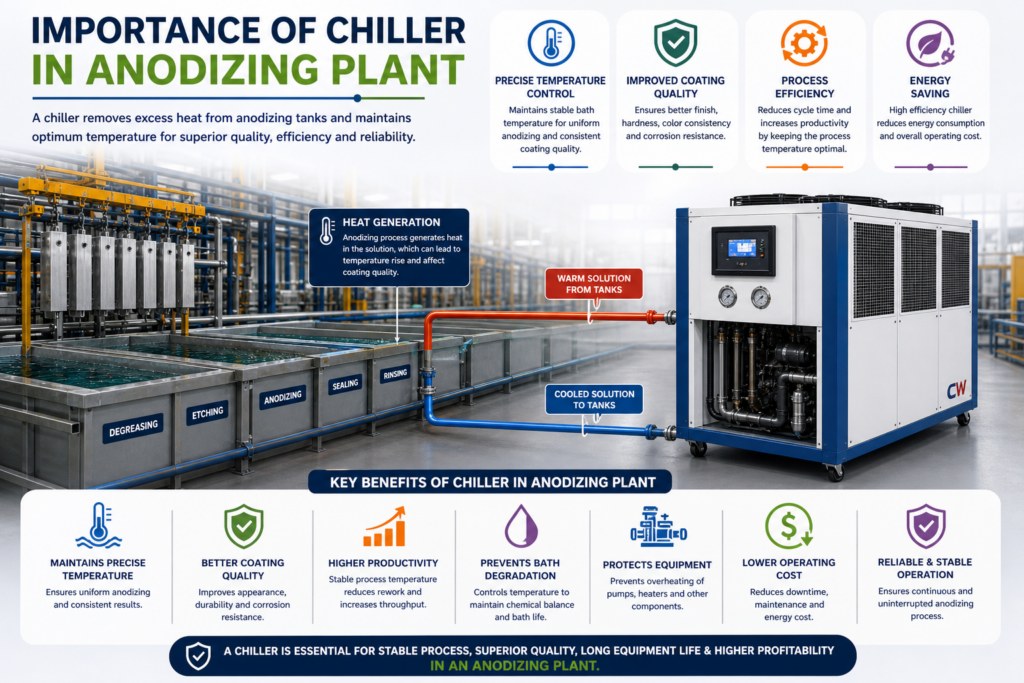
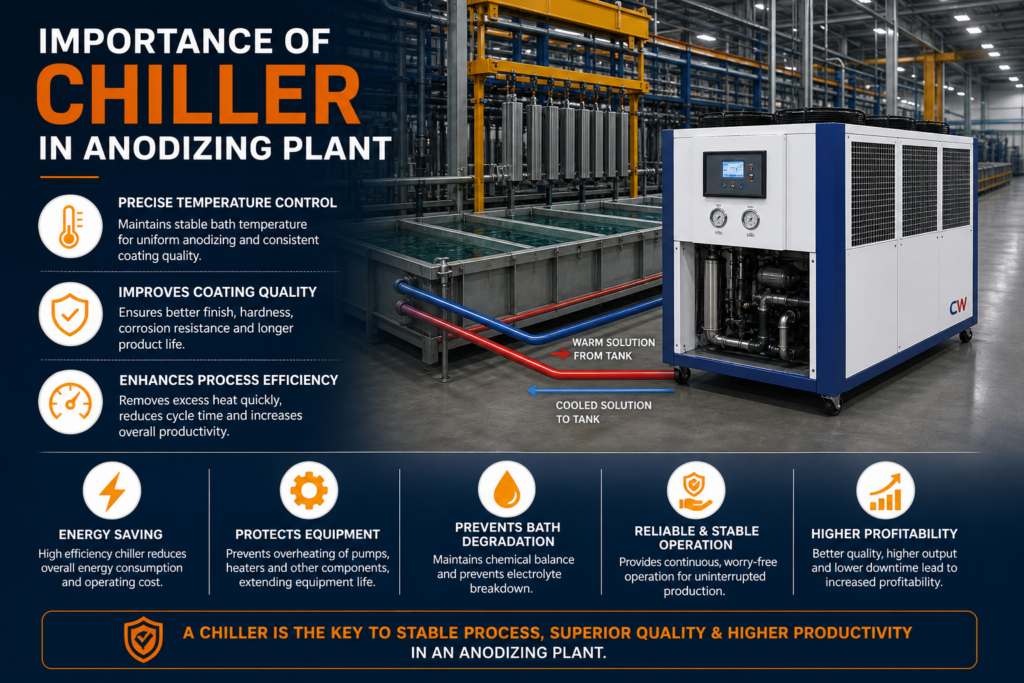
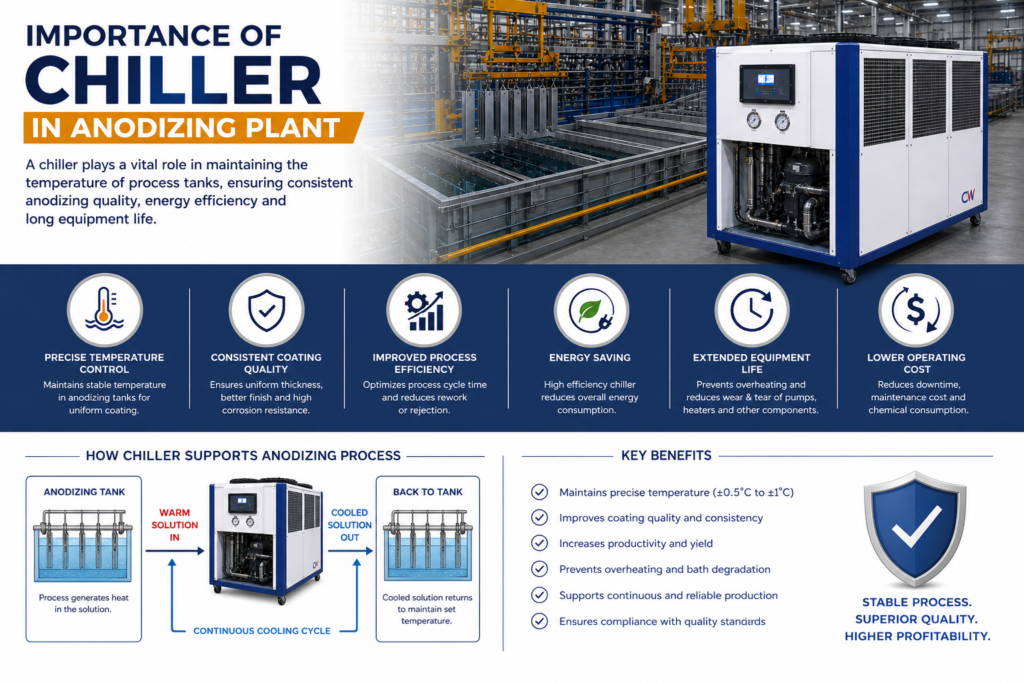
In industrial anodizing plants, precise temperature control is essential for producing high-quality anodized coatings. This is especially important in both soft anodizing and hard anodizing processes, where bath temperature directly affects coating thickness, hardness, surface finish, and corrosion resistance.
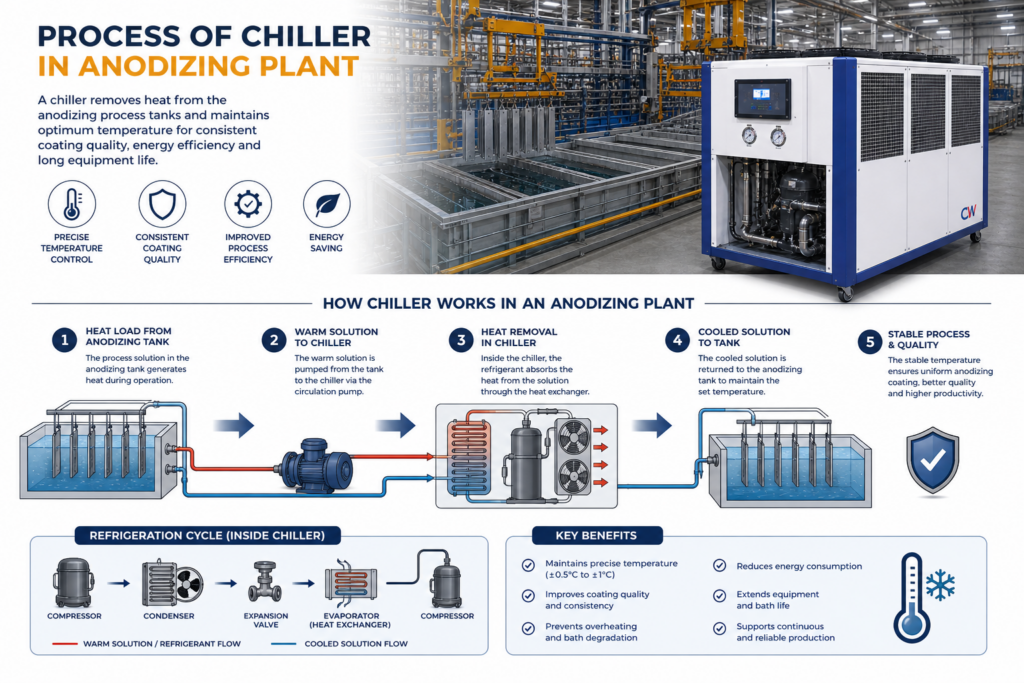
During anodizing, electrical current passing through the electrolyte generates significant heat within the process tank. If this heat is not removed efficiently, bath temperatures can rise beyond the required operating range, resulting in coating defects, uneven oxide formation, reduced hardness, color variations, and increased product rejection.
An industrial chiller for anodizing plants continuously removes excess process heat and maintains a stable electrolyte temperature through cooling coils or heat exchangers. This ensures consistent process conditions, improved coating quality, and reliable production performance.
For soft anodizing, chillers help maintain uniform coating thickness, color consistency, and surface finish. For hard anodizing, which typically operates at lower temperatures, a high-performance chiller is critical for achieving dense, hard, and wear-resistant oxide layers.
By providing accurate and reliable temperature control, anodizing plant chillers improve process stability, reduce downtime, increase production efficiency, and ensure consistent product quality across industrial anodizing operations.
Maintaining the correct anodizing bath temperature provides several important advantages:
🔷 Improves coating uniformity and surface finish
🔷 Prevents overheating of anodizing solution
🔷 Reduces rejection and rework
🔷 Enhances corrosion resistance of aluminum parts
🔷 Maintains consistent color quality
🔷 Improves process stability and productivity
🔷 Protects pumps, rectifiers, and process equipment
🔷 Reduces operating and maintenance costs
Understanding the Anodizing Cooling Process
To understand the importance of a chiller in an anodizing plant, it is necessary to first understand how the anodizing process works.
The anodizing process typically involves several stages:
🔷 Degreasing and cleaning
🔷 Etching and surface preparation
🔷 Anodizing process
🔷 Rinsing and sealing
🔷 Dyeing or finishing process
Among these stages, the anodizing process itself generates a significant amount of heat and requires precise temperature control for stable operation and consistent coating quality.
During anodizing, aluminum components are immersed in an electrolyte solution while electrical current passes through the bath. This electrochemical reaction generates heat continuously inside the anodizing tank.
If the bath temperature increases beyond the recommended range, several problems can occur:
✖ Poor coating quality
✖ Uneven anodizing thickness
✖ Color variation and surface defects
✖ Reduced corrosion resistance
✖ Increased rejection and rework
✖ Shortened chemical bath life
This is why maintaining stable bath temperature is critical in anodizing plants.
Why Chillers Are Important for Anodizing Plants
Many small anodizing units initially rely on cooling towers or manual water circulation systems.
While these methods may provide limited cooling, they cannot maintain the precise temperature control required for modern anodizing operations.
A properly designed industrial chiller offers several important advantages.
1. Maintains Stable Anodizing Bath Temperature
During the anodizing process, continuous heat generation increases the electrolyte temperature. A chiller removes excess heat from the anodizing bath and maintains a stable process temperature.
Stable bath temperature ensures:
🔷 Uniform oxide coating formation
🔷 Better surface finish
🔷 Consistent anodizing quality
🔷 Improved corrosion resistance
2. Improves Product Quality
A chiller helps maintain precise temperature control throughout the anodizing cycle. Consistent cooling improves coating uniformity, color consistency, hardness, and overall finish quality.
Industries such as architectural aluminum, automotive parts, electronics, aerospace, and decorative aluminum products require strict temperature control to achieve high-quality anodized surfaces.
3. Protects Anodizing Equipment
3. Protects Anodizing Equipment
Anodizing systems operate continuously under high electrical and thermal loads. Excessive heat can negatively affect pumps, rectifiers, heat exchangers, seals, and piping systems.
Industrial chillers help protect critical anodizing equipment by preventing overheating and maintaining stable operating conditions.
This improves equipment reliability, reduces maintenance requirements, and increases overall plant efficiency.
Types of Chillers Used in Anodizing Plants
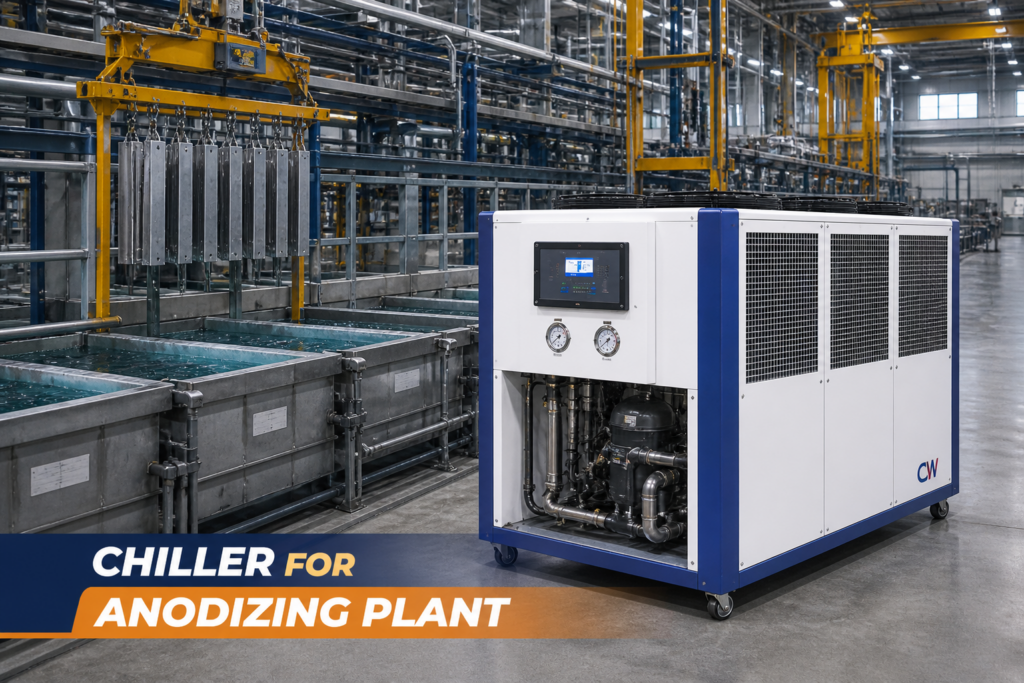
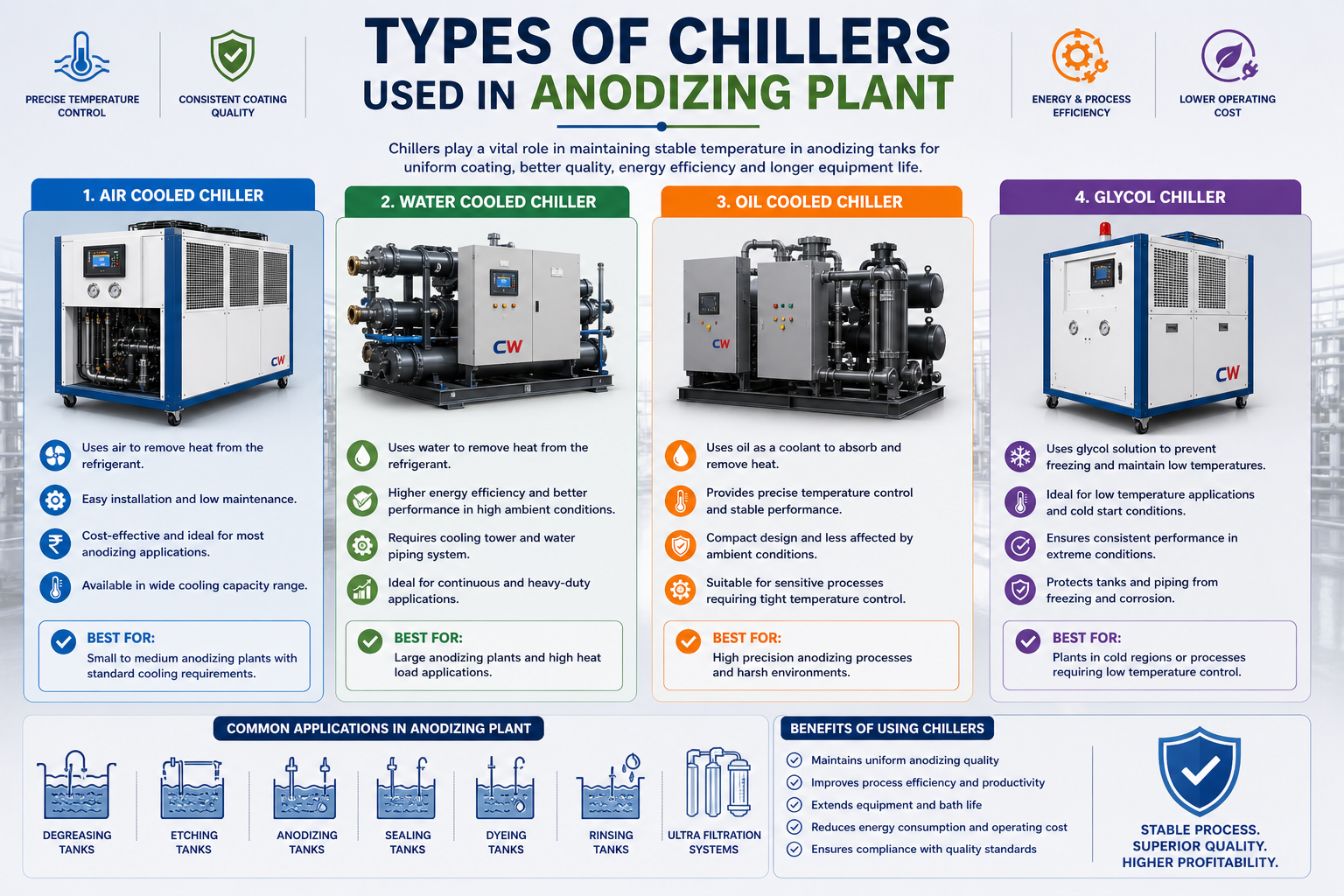
Air-cooled and water-cooled industrial chillers are widely used in anodizing plants for effective process cooling and precise bath temperature control.
They help manufacturers maintain stable anodizing temperatures, improve coating quality, reduce rejection rates, and ensure reliable plant operation.
Air Cooled Chiller
Air-cooled chillers remove heat using ambient air through condenser coils and cooling fans. They are ideal for anodizing plants where easy installation, compact design, and low water consumption are important. These chillers are commonly used in small to medium anodizing plants and applications where cooling towers are not available.
Water-Cooled Chiller
Water-cooled chillers use a cooling tower and water-cooled condenser system to remove process heat efficiently. They are widely used in large anodizing plants requiring continuous operation, precise temperature stability, and high cooling efficiency.
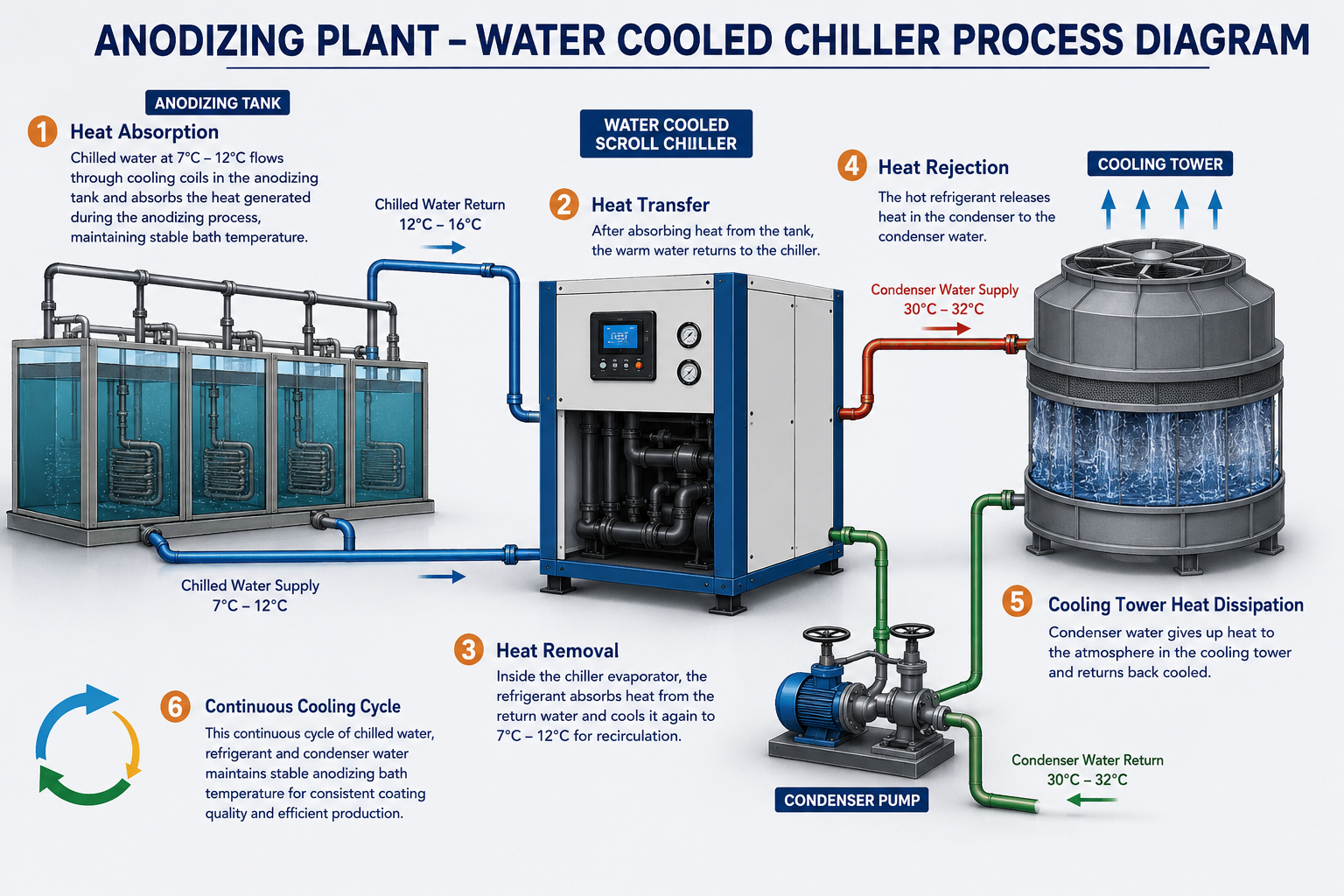
Process of Anodizing Cooling using a Water-Cooled Chiller
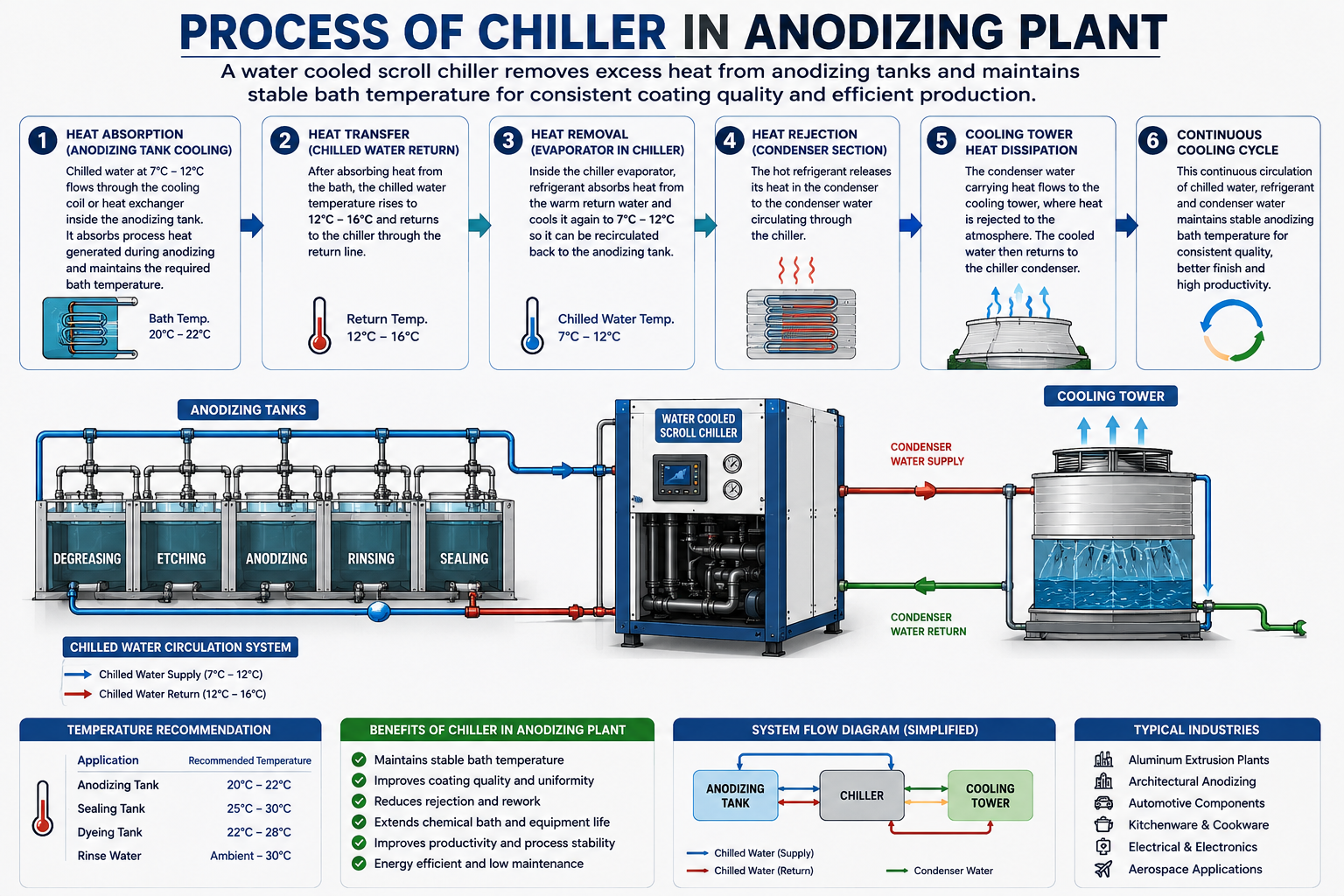
Step-by-Step Working Process
Heat Absorption (Anodizing Tank Cooling)
Chilled water at 7°C – 12°C circulates through cooling coils or heat exchangers connected to the anodizing tank. During the anodizing process, electrical current passing through the electrolyte solution generates significant heat. The chilled water absorbs this excess heat and helps maintain the required bath temperature for stable anodizing operation.
Heat Transfer (Chilled Water Return)
After absorbing heat from the anodizing bath, the chilled water temperature rises to approximately 12°C – 16°C and returns to the water-cooled chiller through the chilled water return line.
Heat Removal (Evaporator in Chiller)
Inside the chiller evaporator, refrigerant absorbs heat from the returning warm water. This process cools the water again to the required temperature range of 7°C – 12°C so it can be recirculated back to the anodizing tank.
Heat Rejection (Condenser Section)
The heated refrigerant transfers its heat to the condenser water inside the condenser section of the water-cooled chiller system.
Cooling Tower Heat Dissipation
The condenser water carrying process heat flows to the cooling tower, where the heat is released into the atmosphere. The cooled condenser water then returns back to the chiller condenser for continuous operation.
Continuous Cooling Cycle
This continuous circulation of chilled water, refrigerant, and condenser water maintains stable anodizing bath temperature throughout the production process.
Proper cooling helps ensure:
🔷 Consistent anodizing quality
🔷 Uniform oxide coating thickness
🔷 Better surface finish
🔷 Reduced rejection rates
🔷 Improved corrosion resistance
🔷 Stable and efficient plant operation
A properly designed water-cooled chiller system is essential for maintaining precise temperature control in modern anodizing plants and metal finishing industries.
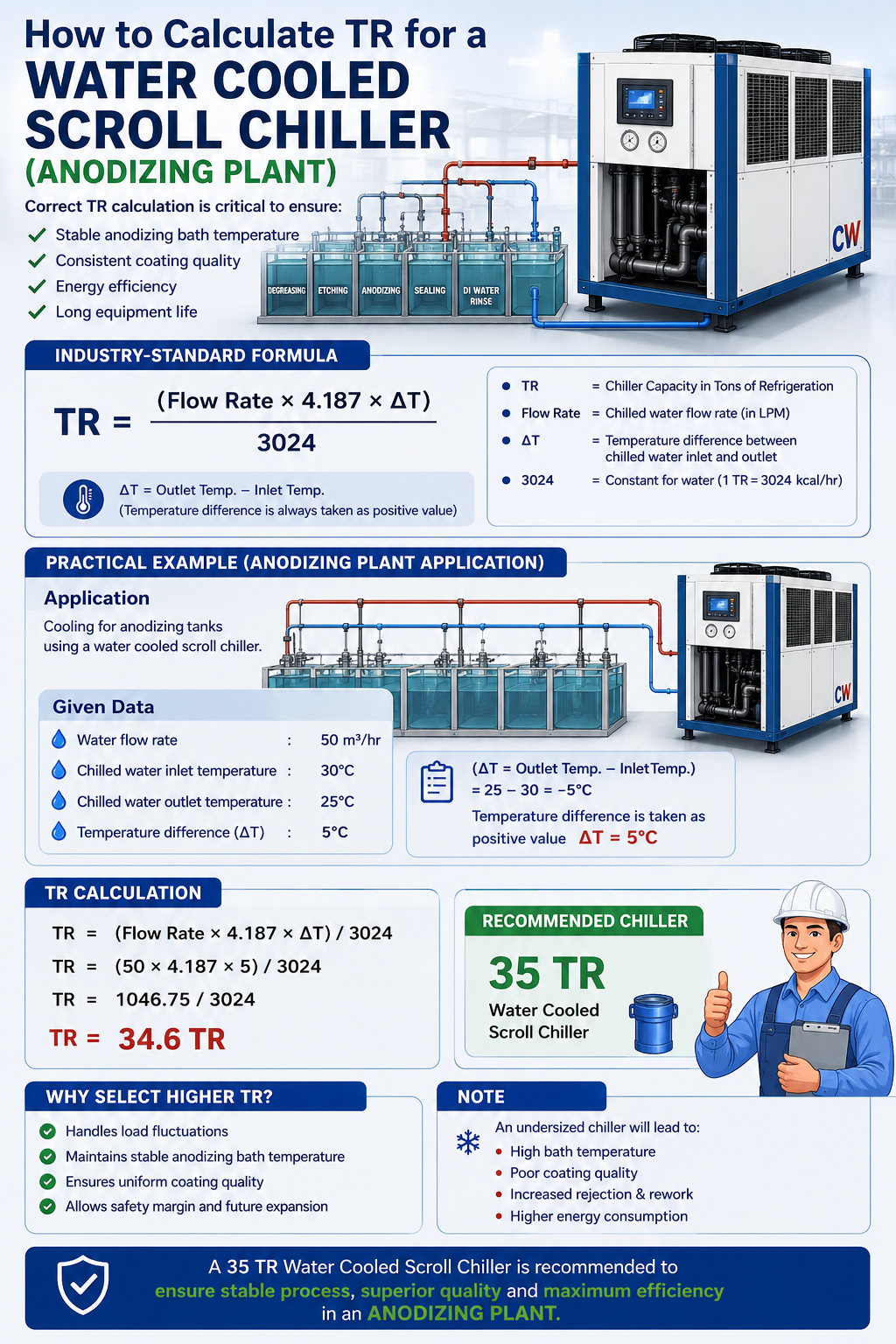
How to Calculate Water Cooled Scroll Chiller Capacity in TR (With Example)
TR=3024
Flow Rate×4.187×ΔT
Where:
🔷 Flow Rate = Chilled water flow in m³/hr
🔷 ΔT = Temperature difference between inlet & outlet water (°C)
🔷 4.187 = Specific heat of water
🔷 3024 = Conversion constant
Practical Example (Anodizing Plant Application)
Application:
Cooling for an anodizing tank using a water cooled scroll chiller
Given Data:
🔷 Water flow rate = 50 m³/hr
🔷 Chilled water inlet temperature = 12°C
🔷 Chilled water outlet temperature = 7°C
🔷 Temperature difference (ΔT) = 5°C
TR Calculation
TR=302450×4.187×5
TR=30241046.75
TR≈34.6
Recommended Chiller Selection
A 35 TR Water Cooled Scroll Chiller is recommended to:
🔷 Handle process load fluctuations
🔷 Maintain stable anodizing bath temperature
🔷 Improve anodizing coating consistency
🔷 Ensure reliable continuous operation
🔷 Allow safety margin and future plant expansion
Proper chiller selection helps anodizing plants achieve better cooling efficiency, reduced rejection rates, and improved overall production performance.
Request For Free Consultation
Request a Free Consultation from a Leading Chiller Manufacturer
“Get technical consultation from a certified chiller manufacturer and supplier.
We help you select the right chiller system for maximum efficiency and precise temperature control.“
Key Components & Applications
Scroll Compressors
Multiple scroll compressors are often used for:
🔷 Better part-load efficiency
🔷 Reliable continuous operation
🔷 Smooth cooling capacity control
🔷 Reduced energy consumption
🔷 Improved system redundancy and reliability
Shell & Tube Evaporator
Ensures efficient heat transfer between chilled water and refrigerant for stable process cooling.
Benefits:
🔷 High cooling efficiency
🔷 Stable chilled water temperature
🔷 Easy maintenance and cleaning
🔷 Long operational life
Shell & Tube Condenser
Transfers heat from refrigerant to condenser water with high efficiency.
Benefits:
🔷 Efficient heat rejection
🔷 Improved cooling performance
🔷 Lower energy consumption
🔷 Reliable operation in industrial environments
Expansion Valve
Maintains precise refrigerant flow according to cooling load requirements.
Benefits:
🔷 Stable cooling control
🔷 Improved energy efficiency
🔷 Better temperature accuracy
🔷 Smooth chiller operation
Control Panel
Microprocessor-based control systems provide accurate temperature monitoring, safety protection, and energy optimization.
Features:
🔷 Digital temperature control
🔷 Safety alarms and protection systems
🔷 Automatic compressor sequencing
🔷 Energy-efficient operation monitoring
Typical Applications of Water Cooled Scroll Chillers in Anodizing Industry
Water cooled scroll chillers are widely used in anodizing and metal finishing industries where precise and stable cooling is essential for maintaining coating quality and process reliability.
Anodizing Tanks
Maintains stable electrolyte temperature for consistent anodizing quality and improved surface finish.
Sealing Tanks
Controls process temperature for proper sealing and enhanced corrosion resistance.
Dyeing Tanks
Provides precise cooling for uniform color consistency during aluminum dyeing processes.
Electroplating & Metal Finishing Plants
Supports stable cooling for various metal treatment and surface finishing applications.
Chemical Processing Industries
Used for temperature-sensitive chemical reactions and industrial process cooling applications.
Industrial Process Cooling Systems
Widely used in industries requiring continuous cooling, energy efficiency, and reliable process temperature control.