

Energy efficiency is one of the most important factors when selecting a chiller, especially with rising electricity costs and increasing focus on sustainable operations. A common question asked by plant managers, consultants, and business owners is:
“Which is more energy efficient – an air-cooled chiller or a water-cooled chiller?”
The short answer is: Water-cooled chillers are generally more energy efficient, but the full answer depends on application, capacity, operating hours, and site conditions.
This article explains the energy efficiency comparison between air-cooled and water-cooled chillers in a practical and easy-to-understand way, helping you choose the right system for long-term savings.
Understanding Energy Efficiency in Chillers
Before comparing both systems, it’s important to understand how chiller energy efficiency is measured.
Common efficiency indicators include:
- COP (Coefficient of Performance)
- EER (Energy Efficiency Ratio)
- kW/TR
A lower kW/TR value means better energy efficiency, as the chiller consumes less power to produce the same cooling output.
How Air-Cooled Chillers Consume Energy
An air-cooled chiller rejects heat directly to the surrounding air using condenser coils and fans.
Energy Consumption Factors in Air-Cooled Chillers
- Compressor power
- Condenser fan motors
- Ambient air temperature
- Airflow conditions
As ambient temperature rises, the condenser becomes less effective, forcing the compressor to work harder. This increases power consumption significantly during peak summer conditions.
Typical Efficiency Range
- kW/TR: 0.9 to 1.3
- COP: Lower compared to water-cooled systems
Air-cooled chillers are most energy efficient in moderate climates and for smaller capacities.
How Water-Cooled Chillers Consume Energy
A water-cooled chiller rejects heat through water, which is cooled further in a cooling tower.
Energy Consumption Factors in Water-Cooled Chillers
- Compressor power
- Condenser water pump
- Cooling tower fan and pump
- Water temperature entering condenser
Since water has much better heat transfer properties than air, water-cooled chillers operate at lower condensing temperatures, which significantly improves compressor efficiency.
Typical Efficiency Range
- kW/TR: 0.55 to 0.75
- COP: Higher than air-cooled chillers
Even after including cooling tower and pump power, water-cooled chillers remain more energy efficient for medium to large capacities.
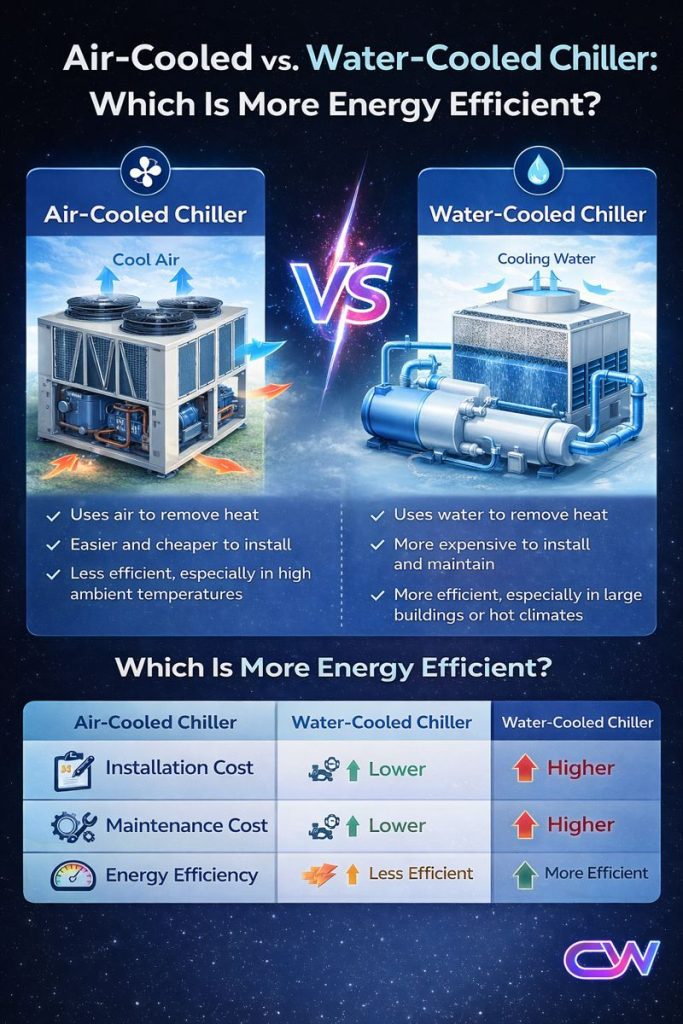
Direct Energy Efficiency Comparison
Air-Cooled Chiller
- Higher compressor power
- Efficiency drops at high ambient temperature
- Simple system but higher electrical consumption
Water-Cooled Chiller
- Lower compressor power
- Stable performance throughout the year
- Additional power for pumps and cooling tower, but overall lower kW/TR
👉 Winner in energy efficiency: Water-cooled chiller
Impact of Ambient Temperature
Ambient temperature plays a major role in energy efficiency.
- Air-cooled chillers are directly exposed to outdoor temperature
- High ambient = higher condensing pressure = higher power consumption
Water-cooled chillers are less affected because:
- Cooling tower water temperature remains relatively stable
- Heat rejection is more efficient
In hot regions, the energy efficiency gap between air-cooled and water-cooled chillers becomes even wider.
Part-Load Efficiency Comparison
Most chillers do not operate at full load all the time.
Air-Cooled Chillers
- Limited part-load efficiency
- Fan cycling increases energy use
- Less effective during variable load conditions
Water-Cooled Chillers
- Excellent part-load efficiency
- Works efficiently with VFD compressors
- Ideal for 24/7 and fluctuating loads
👉 Better part-load efficiency: Water-cooled chiller
Capacity Range and Energy Efficiency
Small Capacity (Below 30–40 TR)
- Energy efficiency difference is marginal
- Air-cooled chillers are often preferred due to lower installation cost
Medium Capacity (50–150 TR)
- Water-cooled chillers show clear energy savings
- Faster return on investment through power savings
Large Capacity (Above 150 TR)
- Water-cooled chillers are significantly more efficient
- Air-cooled chillers become expensive to operate
Annual Energy Cost Comparison (Example)
Let’s assume:
- Cooling load: 100 TR
- Operating hours: 6000 hours/year
Air-Cooled Chiller
- kW/TR = 1.0
- Power consumption = 100 kW
- Annual energy = 600,000 units
Water-Cooled Chiller
- kW/TR = 0.65
- Power consumption = 65 kW
- Annual energy = 390,000 units
Annual saving = 210,000 units, which translates to substantial cost savings every year.
Water Consumption vs Energy Savings
One concern with water-cooled chillers is water usage.
- Air-cooled chillers consume zero water
- Water-cooled chillers require make-up water for cooling tower
However, in many industrial plants, the energy cost savings outweigh water costs, especially for continuous operations.
Maintenance and Its Impact on Efficiency
Poor maintenance reduces energy efficiency in both systems.
Air-Cooled Chillers
- Dirty condenser coils increase power consumption
- Blocked airflow reduces heat rejection
Water-Cooled Chillers
- Scaling in condenser tubes reduces efficiency
- Poor water treatment increases energy use
Proper maintenance ensures both systems operate at designed efficiency.
Which One Is More Energy Efficient in Real Life?
Water-cooled chillers are more energy efficient when:
- Cooling load is medium to large
- Operating hours are long
- Ambient temperature is high
- Energy cost is a major concern
Air-cooled chillers are suitable when:
- Load is small
- Water availability is limited
- Operating hours are low
- Simplicity is preferred over maximum efficiency
How Chillerwala Helps You Choose the Most Efficient Chiller
At Chillerwala, energy efficiency analysis includes:
- Heat load calculation
- Operating hours study
- Ambient and site conditions
- Power and water cost comparison
This ensures customers get the lowest total cost of ownership, not just a lower initial price.
Conclusion
When comparing air-cooled vs water-cooled chillers, water-cooled systems clearly offer higher energy efficiency, especially for medium to large capacities and continuous operations. While air-cooled chillers are simpler and water-free, their higher power consumption makes them less efficient in the long run.
Choosing the right chiller is about balancing energy efficiency, operating cost, water availability, and application needs.