

Selecting the right chiller capacity is not just about choosing a machine with higher TR. A properly selected chiller must match the actual cooling demand, operating conditions, and future requirements of the application. Choosing the wrong capacity—either undersized or oversized—can lead to unstable temperatures, high electricity bills, frequent breakdowns, and reduced equipment life.
In this article, we explain the key factors that affect chiller capacity selection, helping engineers, plant managers, and decision-makers choose the right chiller for reliable and efficient operation.
Why Chiller Capacity Selection Matters
Chiller capacity is usually expressed in TR (Ton of Refrigeration) or kW. The selected capacity directly affects:
- Cooling performance
- Energy efficiency
- System reliability
- Operating and maintenance cost
- Equipment life
A correctly sized chiller operates smoothly, whereas an incorrectly sized one creates continuous operational problems.
1. Process Heat Load
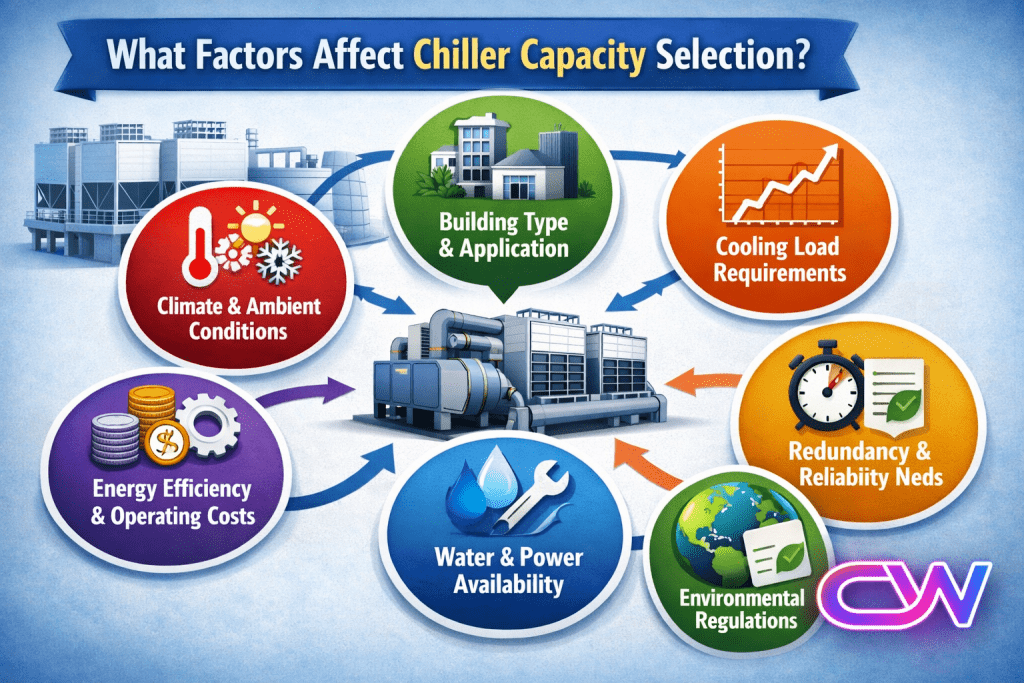
The most important factor in chiller capacity selection is the actual heat load generated by the process or equipment.
Heat load may come from:
- Machines (injection molding, extrusion, CNC, compressors)
- Electrical panels
- Chemical or pharmaceutical reactions
- HVAC cooling demand
Each machine or process generates heat that must be removed continuously. The total heat load determines the minimum TR requirement.
Tip: Always calculate heat load based on actual operating conditions, not machine nameplate values.
2. Required Cooling Temperature
The inlet and outlet water temperature has a major impact on chiller capacity.
Example:
- Cooling water from 15°C to 10°C (ΔT = 5°C)
- Cooling water from 20°C to 10°C (ΔT = 10°C)
Lower outlet temperatures require more chiller capacity and higher compressor power. Applications such as pharmaceuticals, laser cooling, and chemical processing often need precise low temperatures, which directly increases capacity requirements.
3. Flow Rate of Cooling Medium
The flow rate of water or glycol plays a critical role in capacity selection.
Higher flow rate = higher heat removal = higher TR requirement
Flow rate depends on:
- Process design
- Machine manufacturer recommendation
- Heat transfer requirements
Incorrect assumptions about flow rate can result in poor cooling or excessive energy consumption.
4. Type of Cooling Medium (Water or Glycol)
Chiller capacity changes depending on the cooling fluid used.
- Water has high heat transfer efficiency
- Glycol mixtures (ethylene or propylene) reduce freezing risk but also reduce heat transfer efficiency
When glycol is used, chiller capacity must be increased by 10–30%, depending on glycol concentration.
This factor is often overlooked during chiller selection.
5. Ambient Temperature Conditions
Ambient temperature directly affects chiller performance, especially for air-cooled chillers.
- High ambient temperature reduces heat rejection efficiency
- Compressor works harder
- Actual chiller capacity drops
For hot regions, capacity selection must consider maximum summer ambient temperature, not average conditions.
Water-cooled chillers are less affected but still require proper cooling tower design.
6. Type of Chiller (Air-Cooled vs Water-Cooled)
The cooling method significantly influences capacity selection.
Air-Cooled Chillers
- Easier installation
- Higher power consumption
- Capacity derates at high ambient temperature
Water-Cooled Chillers
- Higher efficiency
- Stable performance
- Requires cooling tower and water availability
For the same TR requirement, an air-cooled chiller may need a slightly higher nominal capacity compared to a water-cooled chiller.
7. Compressor Type
Different compressor technologies impact performance and capacity stability.
- Scroll compressors – Best for small capacities and stable loads
- Screw compressors – Suitable for medium to large industrial loads
- Centrifugal compressors – Ideal for very high capacities
Selecting the wrong compressor type can lead to inefficient part-load operation and frequent cycling.
8. Load Variation and Operating Pattern
Not all processes operate at full load all the time.
Important considerations:
- Continuous vs batch process
- Peak load vs average load
- Seasonal variations
- Future expansion
For variable loads, chillers with capacity control or multiple compressors offer better efficiency and temperature stability.
9. Safety Margin and Future Expansion
A safety margin is essential but must be applied wisely.
Recommended safety margin:
- 10% for stable processes
- 15–20% for variable or harsh conditions
Excessive oversizing leads to:
- Short cycling
- Higher capital cost
- Reduced efficiency
Future expansion plans should be discussed during capacity selection to avoid premature system replacement.
10. Energy Efficiency Requirements
Energy efficiency is a critical factor in modern chiller selection.
Factors influencing efficiency:
- COP and EER values
- Part-load efficiency
- Compressor control logic
- Heat exchanger design
Selecting a slightly higher-efficiency chiller often results in lower long-term operating cost, even if initial cost is higher.
11. Space and Installation Constraints
Available space affects:
- Chiller size
- Heat rejection method
- Maintenance accessibility
Restricted space may require:
- Compact chiller design
- Vertical airflow arrangement
- Modular chiller systems
Ignoring space constraints leads to installation difficulties and poor service access.
12. Water Quality and Availability
For water-cooled systems, water quality plays a major role.
Poor water quality causes:
- Scaling
- Corrosion
- Reduced heat transfer
This impacts actual capacity and long-term performance. Proper filtration and water treatment must be considered during selection.
13. Maintenance and Reliability Expectations
A chiller selected purely on TR without considering maintenance can cause long-term problems.
Consider:
- Ease of servicing
- Availability of spares
- Local service support
- Operating environment
Reliable performance depends not just on capacity, but also on system design and maintenance support.
How Chillerwala Approaches Capacity Selection
At Chillerwala, chiller capacity selection is based on:
- Detailed heat load analysis
- Process understanding
- Site conditions
- Operating hours
- Energy efficiency goals
This approach ensures that the selected chiller delivers stable cooling, optimal efficiency, and long service life.
Conclusion
Chiller capacity selection is influenced by multiple factors—not just TR calculation. Process heat load, temperature requirements, ambient conditions, cooling medium, compressor type, and future plans all play a vital role. A well-selected chiller operates efficiently, reduces operating costs, and ensures reliable performance.
Taking time to understand these factors leads to better decisions and long-term benefits.