

Batching Plant Chiller
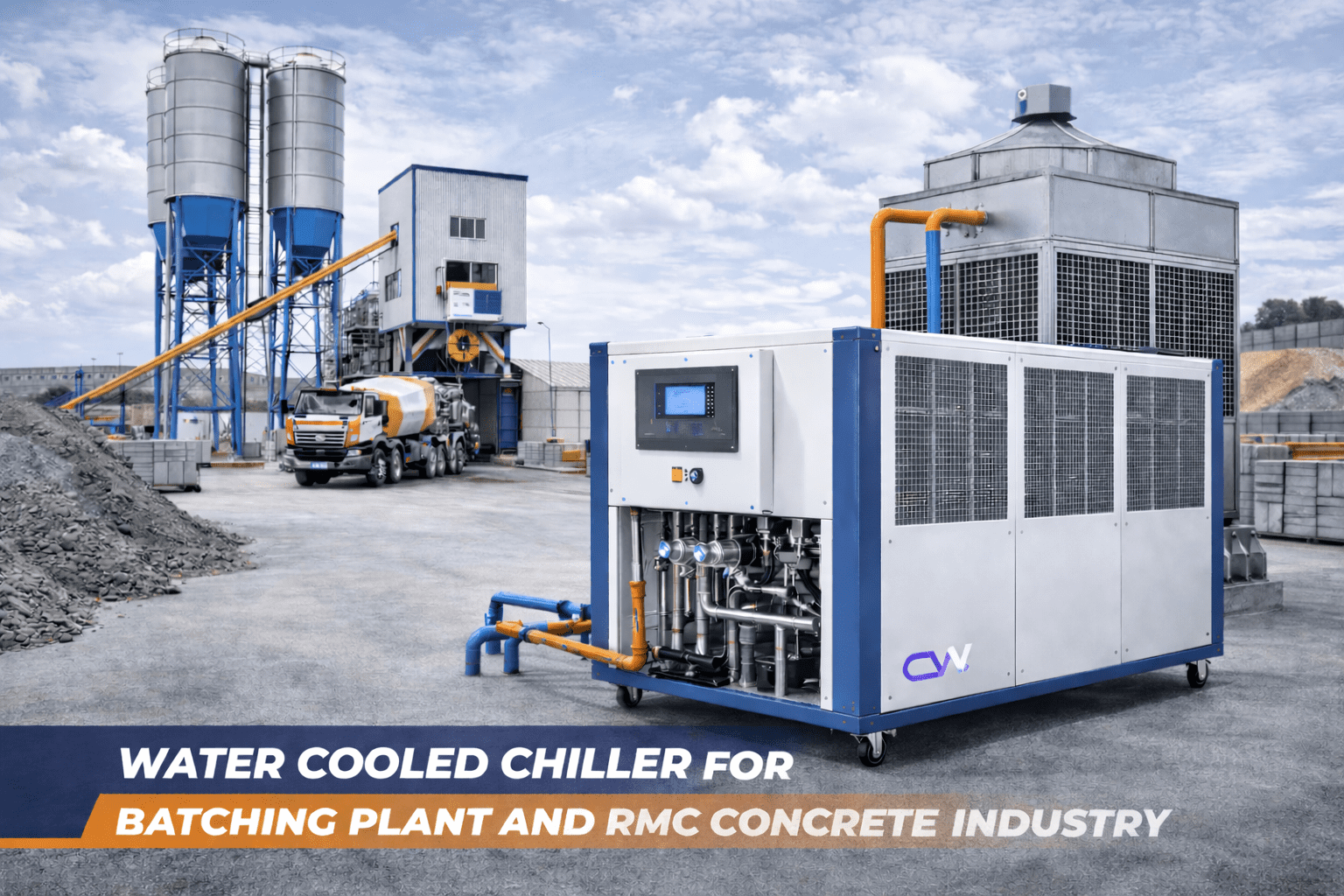
Batching Plant Chiller – Essential Cooling Solution for Quality Concrete Production
In the construction industry, consistency is everything. Whether it’s a high-rise building, bridge, metro project, dam, or highway, the strength and durability of concrete depend heavily on controlled temperature during mixing and curing. This is where a Batching Plant Chiller plays a critical role.
Many site engineers and project managers focus on cement quality, aggregates, and mix ratios but often overlook one key factor — water temperature. During hot weather, especially in Indian climatic conditions, high water temperature directly affects concrete setting time, strength, and workability.
A Batching Plant Chiller ensures that chilled water is supplied to the concrete batching process, maintaining the correct temperature and improving overall concrete quality.
What Is a Batching Plant Chiller?
A Batching Plant Chiller is an industrial cooling system designed to reduce the temperature of water used in concrete batching plants. The chilled water is mixed with cement, sand, aggregates, and admixtures to control the concrete temperature during mixing.
By maintaining low water temperature, the chiller helps in:
✅ Controlling initial concrete temperature
✅ Improving setting time
✅ Enhancing concrete strength
✅ Reducing cracks and shrinkage
✅ Ensuring quality concrete even in peak summer
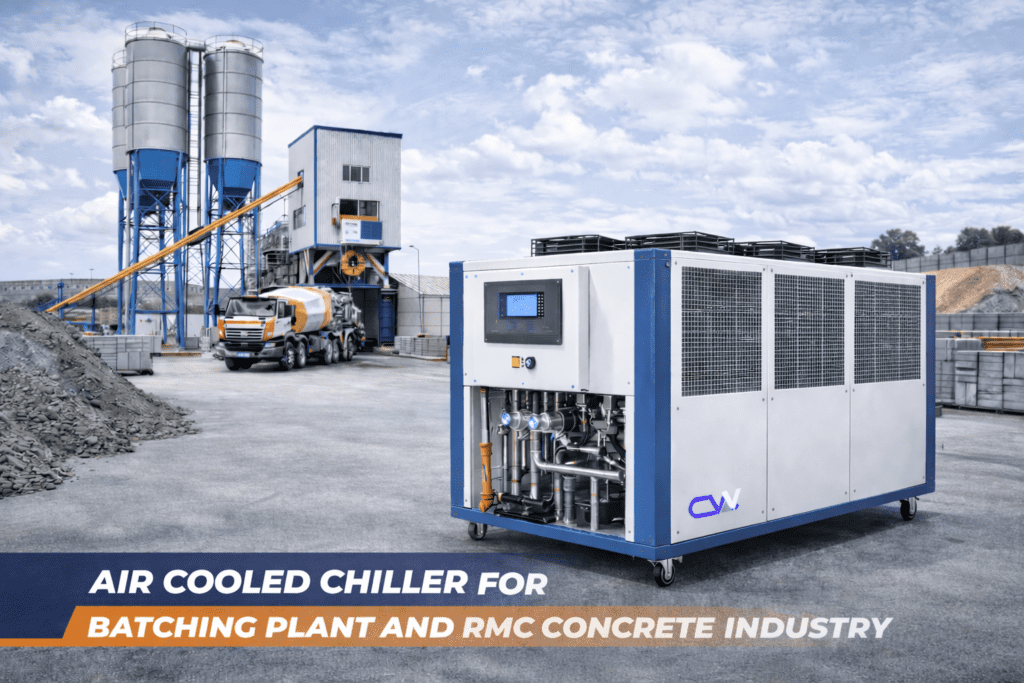
Advantages of Batching Plant Chiller
Industrial batching plant chiller for concrete temperature control in RMC plants. Energy-efficient and reliable.
One
Improves Concrete Strength: Lower water temperature slows down hydration, allowing proper curing and higher compressive strength.
Two
Prevents Concrete Cracks: Temperature control reduces thermal stress and cracking.
Three
Maintains Workability: Concrete remains workable for longer durations, especially during transportation.
Four
Consistent Quality in Summer: Ensures reliable batching even at 45°C ambient temperature.
Five
Supports Large Infrastructure Projects: Essential for dams, bridges, metros, and highways where concrete quality is critical.
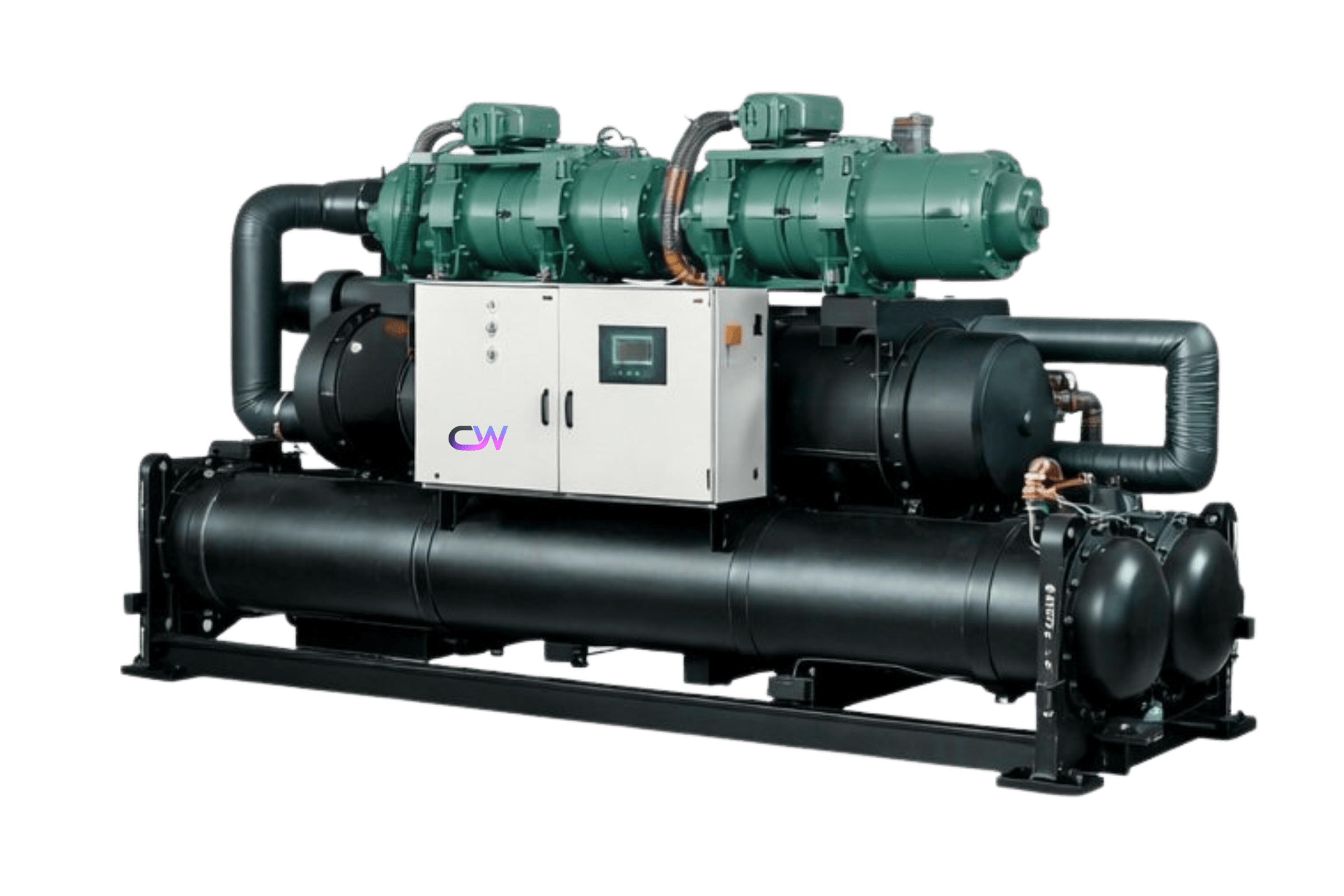
Process of Batching Plant Chiller
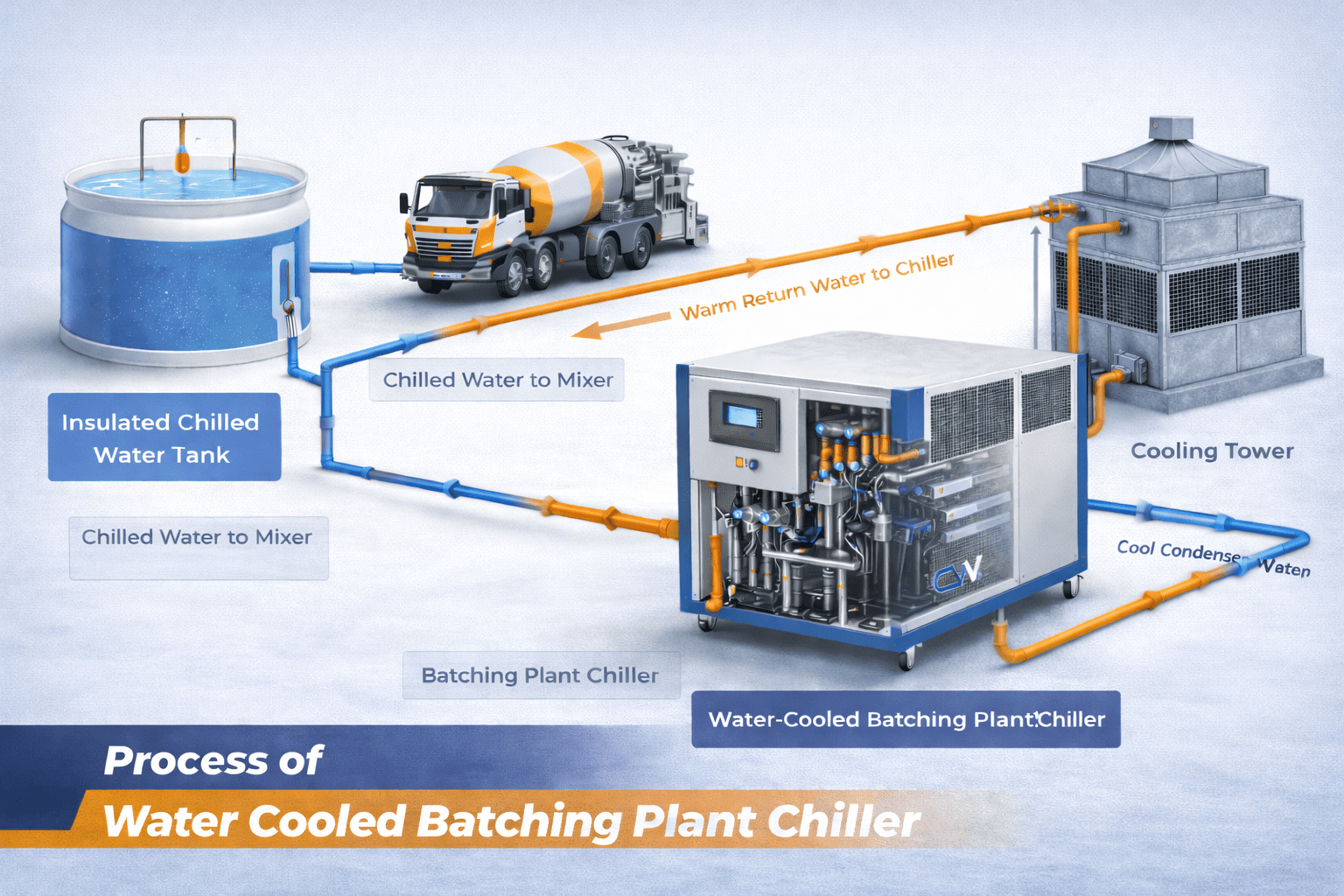

A Batching Plant Chiller plays a critical role in the RMC and concrete industry by controlling the temperature of water used in the concrete mixing process. Maintaining the right water temperature ensures proper cement hydration, consistent concrete strength, and prevents cracks caused by excess heat during mixing.
Here is the simple and effective process of how a batching plant chiller system works:
✅ Step 1: Insulated Chilled Water Storage Tank
Chilled water produced by the chiller is stored in an insulated tank to maintain low temperature without heat gain from the environment. This ensures ready availability of cold water for continuous batching operations.
✅ Step 2: Chilled Water Supply to Concrete Mixer
The chilled water is pumped from the storage tank directly into the concrete mixer during batching. This cool water reduces the overall concrete temperature and controls the heat generated during cement hydration.
✅ Step 3: Heat Absorption During Mixing
As chilled water mixes with cement, aggregates, and sand, it absorbs the heat generated in the mixing process. This prevents the concrete temperature from rising beyond recommended limits.
✅ Step 4: Warm Return Water to Chiller
After absorbing heat, the water becomes warm and returns back to the chiller through the return pipeline for re-cooling.
✅ Step 5: Cooling Process Inside Water-Cooled Chiller
Inside the water-cooled batching plant chiller, the refrigerant cycle removes heat from the returning warm water through the evaporator, cooling it again to the desired temperature.
✅ Step 6: Heat Rejection Through Cooling Tower
The heat extracted by the chiller is transferred to the condenser water, which flows to the cooling tower. The cooling tower releases this heat into the atmosphere and sends cooled condenser water back to the chiller.
✅ Step 7: Continuous Cooling Cycle
This cycle runs continuously during plant operation, ensuring a steady supply of chilled water and maintaining consistent concrete quality regardless of ambient temperature.
How to calculate Capacity of Water cooled chiller for Batching Plant:
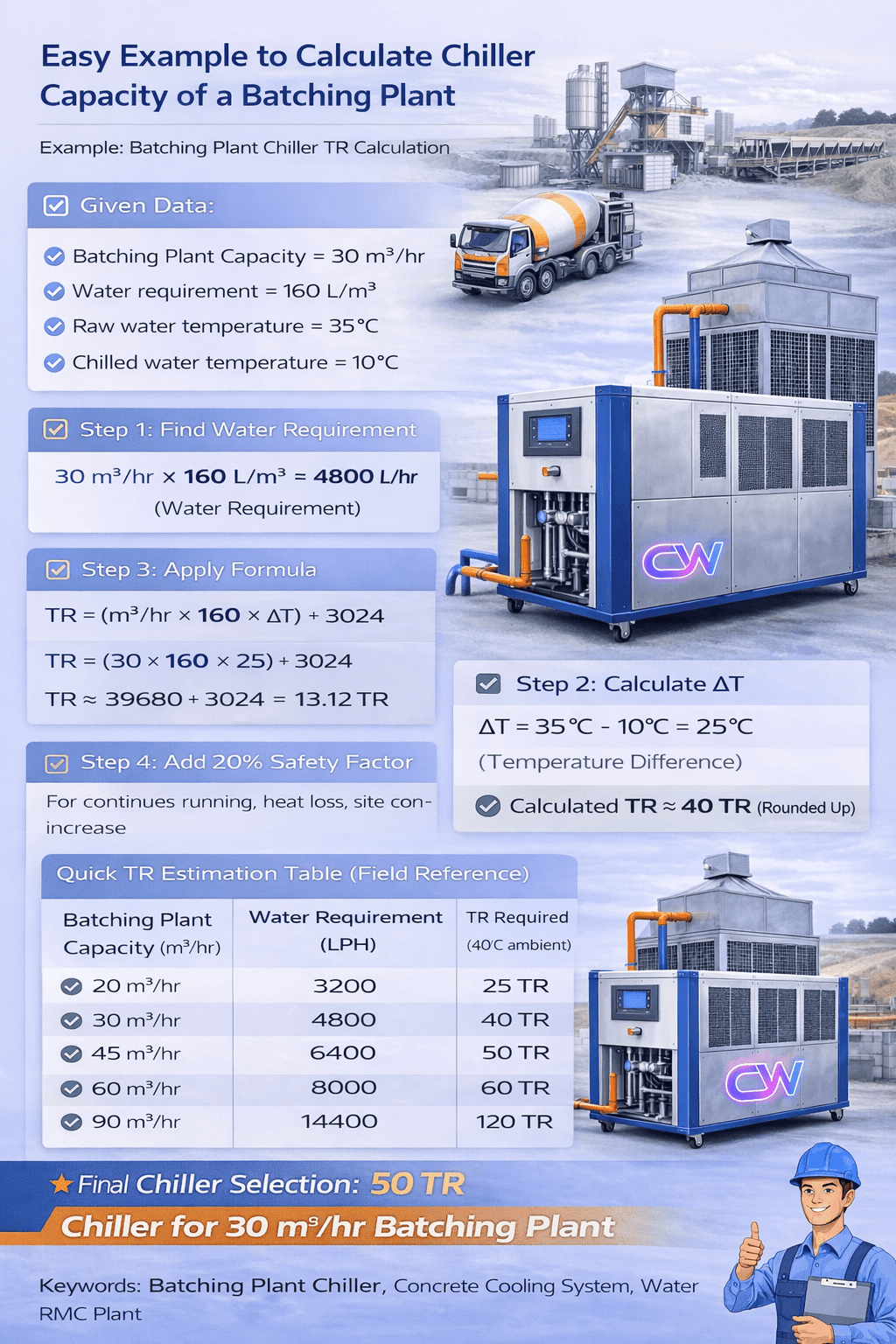
✅ Batching Plant Chiller – TR Capacity Calculation (As per Example Image)
✅ Given Data
Batching Plant Output = 30 m³/hr
Water Requirement = 160 Liters per m³
Raw Water Temperature = 35°C
Required Chilled Water Temperature = 10°C
✅ Step 1 — Calculate Total Water Requirement (LPH)
Water Flow (LPH) = Plant Capacity × Water per m³
Water Flow = 30 × 160 = 4800 LPH
This is the total water that must be cooled every hour.
✅ Step 2 — Calculate Temperature Difference (ΔT)
ΔT = Inlet Water Temp − Required Water Temp
ΔT = 35 − 10 = 25°C
This is the temperature drop the chiller must achieve.
✅ Step 3 — Apply Chiller TR Formula
TR = (LPH × ΔT) ÷ 3024
TR = (4800 × 25) ÷ 3024
TR = 120000 ÷ 3024
TR ≈ 39.68 TR
Rounded Value ≈ 40 TR
✅ Step 4 — Add Safety Factor (20–25%)
For continuous running, heat loss, ambient conditions, and future load:
Required TR = 40 + 20% ≈ 50 TR
✅ Final Chiller Selection for 30 m³/hr Batching Plant
👉 Recommended Chiller Capacity = 50 TR
Request For Free Consultation
Request a Free Consultation from a Leading Chiller Manufacturer
“Get technical consultation from a certified chiller manufacturer and supplier.
We help you select the right chiller system for maximum efficiency and precise temperature control.“
Types & Applications
🔹 Types of Chillers Used in Batching Plants
Batching plant chillers are selected based on site conditions, water availability, ambient temperature, and required cooling load. Choosing the right type ensures consistent concrete quality, faster setting control, and uninterrupted plant operation.
✅ 1) Air Cooled Scroll Chiller
Uses ambient air to reject heat through condenser fans.
Ideal for sites with water scarcity and easy outdoor installation.
Best for: Small to medium batching plants, temporary project sites, remote locations.
✅ 2) Air Cooled Screw Chiller
Designed for higher TR capacity with better efficiency at larger loads.
Handles continuous operation in hot weather conditions.
Best for: Medium to large RMC plants where water is limited but high capacity is required.
✅ 3) Water Cooled Scroll Chiller
Uses cooling tower water for heat rejection.
More energy efficient than air cooled systems for long running hours.
Best for: Plants with cooling tower setup and moderate cooling load.
✅ 4) Water Cooled Screw Chiller
High efficiency industrial chiller for heavy-duty batching plants.
Stable performance even in extreme ambient temperatures.
Best for: Large capacity RMC plants, metro projects, infrastructure sites.
✅ 5) Reciprocating Chiller (Air/Water Cooled)
Robust, simple design, easy maintenance.
Suitable for plants needing rugged and economical solutions.
Best for: Budget projects, moderate cooling demand, simple operations.
🏗️ Applications of Batching Plant Chillers
Batching plant chillers are not only for cooling water — they directly affect concrete strength, setting time, and final quality.
✅ Cooling Mixing Water
Maintains low water temperature before mixing with cement and aggregates.
✅ Controlling Concrete Temperature
Prevents overheating of concrete during mixing and transportation.
✅ RMC (Ready Mix Concrete) Plants
Ensures consistent concrete temperature for long transit and pumping.
✅ Hot Weather Concreting
Essential in summer and high ambient regions to avoid rapid setting and cracks.
✅ Mass Concreting Projects
Used in dams, bridges, and foundations where temperature control is critical.
✅ Infrastructure & Metro Projects
Maintains concrete quality for high-strength structural requirements.
✅ Precast Concrete Industry
Helps achieve uniform curing and better finish in precast elements.
✅ Construction Sites with Continuous Production
Supports 24/7 batching operations without temperature fluctuation.
🎯 Why Proper Chiller Type Selection Matters
✔️ Improves concrete strength and durability
✔️ Reduces rejection and rework
✔️ Ensures faster project completion
✔️ Saves power and operational cost
✔️ Provides stable cooling in harsh site conditions
Choosing the correct batching plant chiller type directly impacts productivity, quality, and profitability of your RMC or construction project.