

When selecting an industrial or HVAC chiller, one of the most important decisions is choosing the right type of compressor. The compressor is the heart of the chiller system, and its type directly affects capacity range, energy efficiency, reliability, operating cost, and application suitability.
Among the most commonly used chillers today are Scroll Chillers, Screw Chillers, and Centrifugal Chillers. While all three perform the same basic function—removing heat—their working principles and ideal use cases are very different.
This article explains the difference between scroll, screw, and centrifugal chillers in a clear and practical way to help you make the right choice.
Why Compressor Type Matters in a Chiller
Choosing the wrong compressor type can result in:
- Higher electricity bills
- Poor part-load efficiency
- Frequent breakdowns
- Unstable temperature control
Each compressor type is designed for a specific capacity range and operating pattern. Understanding these differences helps avoid costly mistakes.
What Is a Scroll Chiller?
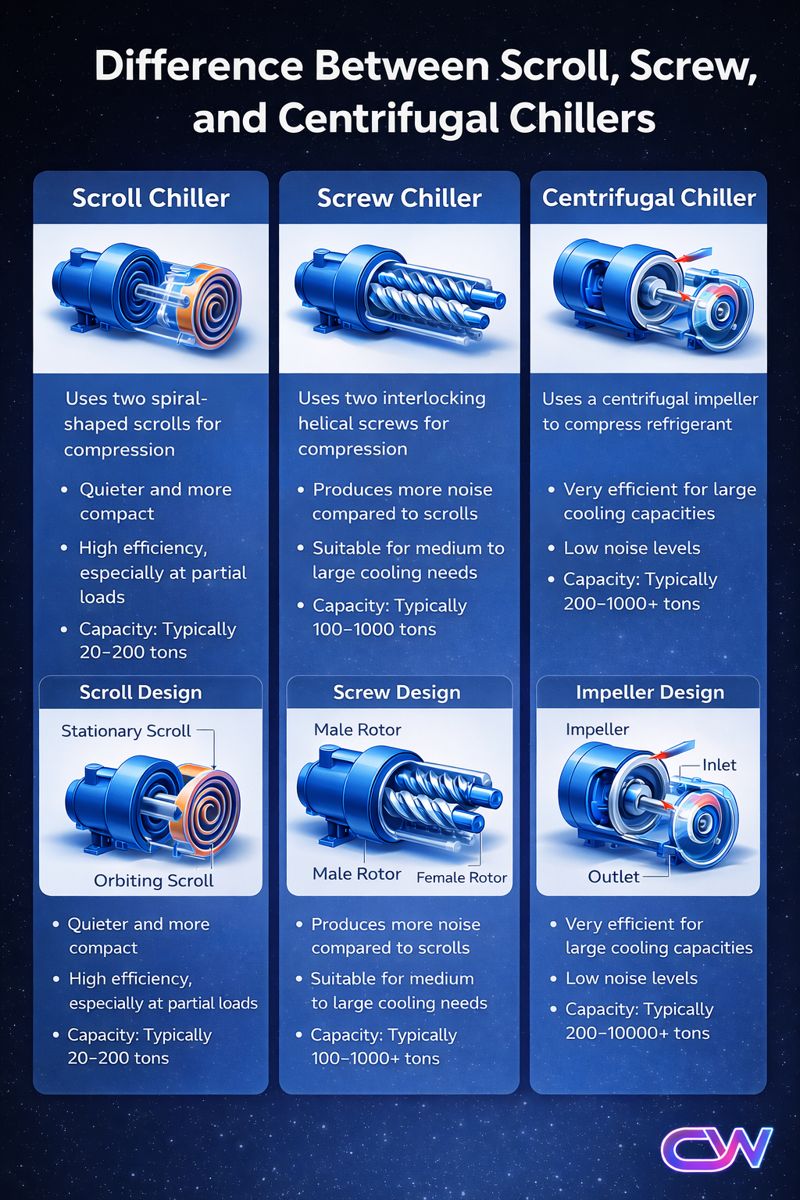
A scroll chiller uses one or more scroll compressors. These compressors consist of two spiral-shaped scrolls—one fixed and one orbiting. As the scrolls move, refrigerant gas is compressed smoothly.
Key Features of Scroll Chillers
- Compact design
- Fewer moving parts
- Low vibration and noise
- High reliability for small loads
Scroll chillers are widely used in small to medium cooling applications where stable and quiet operation is required.
What Is a Screw Chiller?
A screw chiller uses a rotary screw compressor, consisting of two intermeshing helical rotors (male and female). As the rotors turn, refrigerant gas is compressed continuously.
Key Features of Screw Chillers
- Continuous and smooth compression
- High efficiency at part load
- Robust construction
- Suitable for heavy industrial duty
Screw chillers are the most commonly used chillers in medium to large industrial applications.
What Is a Centrifugal Chiller?
A centrifugal chiller uses a centrifugal compressor that increases refrigerant pressure by converting kinetic energy into pressure energy using a high-speed rotating impeller.
Key Features of Centrifugal Chillers
- Very high cooling capacity
- Extremely efficient at full load
- Fewer mechanical parts
- Ideal for large centralized cooling systems
Centrifugal chillers are typically used in large plants, district cooling, airports, malls, and data centers.
Comparison Based on Capacity Range
Scroll Chiller
- Typical range: 2 TR to 60 TR
- Best for small loads and localized cooling
Screw Chiller
- Typical range: 40 TR to 500+ TR
- Ideal for medium to large industrial applications
Centrifugal Chiller
- Typical range: 150 TR to several thousand TR
- Used for very large centralized cooling systems
👉 Capacity winner:
- Small load → Scroll
- Medium to large load → Screw
- Very large load → Centrifugal
Energy Efficiency Comparison
Scroll Chillers
- Efficient at low and steady loads
- Efficiency drops at fluctuating or high loads
Screw Chillers
- Excellent part-load efficiency
- Capacity control via slide valve or VFD
- Performs well in variable load conditions
Centrifugal Chillers
- Highest efficiency at full load
- Part-load efficiency improves significantly with VFD
👉 Best efficiency overall:
- Variable load → Screw chiller
- Large full-load system → Centrifugal chiller
Load Variation Handling
Scroll
- Multiple compressors used for staging
- Not ideal for wide load fluctuations
Screw
- Excellent load modulation
- Stable cooling even at partial load
Centrifugal
- Sensitive to very low loads
- Modern VFD centrifugal chillers handle variation better
👉 Best for fluctuating load: Screw chiller
Installation and Space Requirement
Scroll Chillers
- Compact and skid-mounted
- Easy to install
- Minimal foundation requirement
Screw Chillers
- Larger footprint
- Requires solid foundation
- More auxiliary systems
Centrifugal Chillers
- Large and heavy
- Installed in plant rooms
- Requires detailed planning
👉 Easiest installation: Scroll chiller
Noise and Vibration Levels
Scroll Chillers
- Very low noise
- Suitable for hospitals and commercial buildings
Screw Chillers
- Moderate noise
- Acceptable for industrial environments
Centrifugal Chillers
- Low mechanical noise
- High-speed operation but smoother running
👉 Quietest operation: Scroll & Centrifugal
Maintenance and Reliability
Scroll Chillers
- Minimal maintenance
- Compressor replacement instead of repair
Screw Chillers
- Periodic oil management
- Long service life
- Easy to overhaul
Centrifugal Chillers
- Requires skilled maintenance
- Fewer moving parts
- Long operational life
👉 Best balance of serviceability: Screw chiller
Initial Cost vs Operating Cost
| Parameter | Scroll | Screw | Centrifugal |
|---|---|---|---|
| Initial Cost | Low | Medium | High |
| Operating Cost | Medium | Low | Very Low (large loads) |
| Maintenance Cost | Low | Medium | Medium |
| Lifespan | Medium | Long | Very Long |
Typical Applications
Scroll Chiller Applications
- Small HVAC systems
- Clinics and laboratories
- Small plastic machines
- Office buildings
Screw Chiller Applications
- Plastic injection & extrusion plants
- Pharma and chemical industries
- Food & beverage processing
- Printing and packaging
Centrifugal Chiller Applications
- Large commercial complexes
- Airports and metro stations
- Data centers
- District cooling plants
How to Choose the Right Chiller Type?
Ask these questions:
- What is the required TR capacity?
- Is the load constant or variable?
- How many operating hours per day?
- Is energy efficiency a priority?
- What is the future expansion plan?
Answering these correctly leads to the right compressor selection.
How Chillerwala Helps You Select the Right Chiller
At Chillerwala, chiller selection is not based on capacity alone. It considers:
- Process heat load
- Load variation
- Ambient conditions
- Energy efficiency goals
- Long-term operating cost
This ensures the selected scroll, screw, or centrifugal chiller delivers reliable cooling, high efficiency, and long service life.
Conclusion
Scroll, screw, and centrifugal chillers each have a specific role in industrial and HVAC cooling. Scroll chillers are ideal for small, quiet applications; screw chillers offer the best balance of efficiency and flexibility for industrial use; and centrifugal chillers are unmatched for large-scale cooling.
Understanding these differences helps you invest in the right technology, avoid oversizing or inefficiency, and achieve long-term savings.